
Drawing on 50 interviews with chief legal officers (CLOs), law firm partners, legal operations professionals, and non-lawyer corporate executives around the world, this article posits that the lawyers who will distinguish themselves are those who figure out how to create value-add in an era of AI.
This matters because many of the tasks that lawyers have historically done are threatened by AI. Research shows that law firms and corporate legal departments around the world have deployed both legal purpose-built AI (like Harvey or Legora) and general-purpose AI (like ChatGPT or Gemini) to perform tasks once reserved for teams of junior associates: synthesizing enormous document sets, identifying risks in contract language, analyzing regulatory exposure, drafting and redlining complex agreements, and extracting patterns from thousands of precedents.
This use of AI is creating displacement in legal departments and law firms.
The real question is not whether AI will replace lawyers. It is whether (and how) we will make ourselves irreplaceable.
First, in-house legal departments are bringing more work inside. One interviewee, a CLO at a Fortune 500 global logistics company, described reducing his external counsel spend by $1 million through AI-enabled in-house capability. Another, a CLO at a Fortune 500 technology hardware company, explained that AI enables his team to “attack more issues and do it more effectively without adding more people.” A general counsel (GC) and chief compliance officer at a U.S. health care technology company was starker still: her department has “shifted to a place where everything we do starts with Claude. AI first for everything.” Legal operations leader Mary O’Carroll reported in May 2026 that in-house teams increasingly run every matter through AI before deciding whether to call outside counsel at all. One team told her: “We get to 80 percent on our own, and then we decide if we even need to make the call,” for which the answer is often no.
Second, CLOs are cutting internal head count, too—and planning for more. Many in-house legal departments have already been handed a target: one chief operating officer for legal, governance, and corporate affairs explained that his chief financial officer expects spend on legal services “to go down 30 percent.” A CLO of a large global financial institution already has five “agents” on his org chart, with names and workflow responsibilities, and expects that number to double within a year.
Third, law firms are also displacing lawyers, with the bottom of the pyramid going first. At one global firm, the intern class has been halved from 1,000 interns to 500. A partner at a midsize NYC firm said to me: “AI can’t do my job, but it can do aspects of a junior associate’s”—exactly the work clients no longer want to pay a person to do.
So, the real question is not whether AI will replace lawyers. It is whether (and how) we will make ourselves irreplaceable. My interviewees make it clear that the lawyers who endure won’t be the ones with the best or fastest tools. What differentiates the lawyers who will matter are three human value-adds: Character. Client-centricity. Innovation.
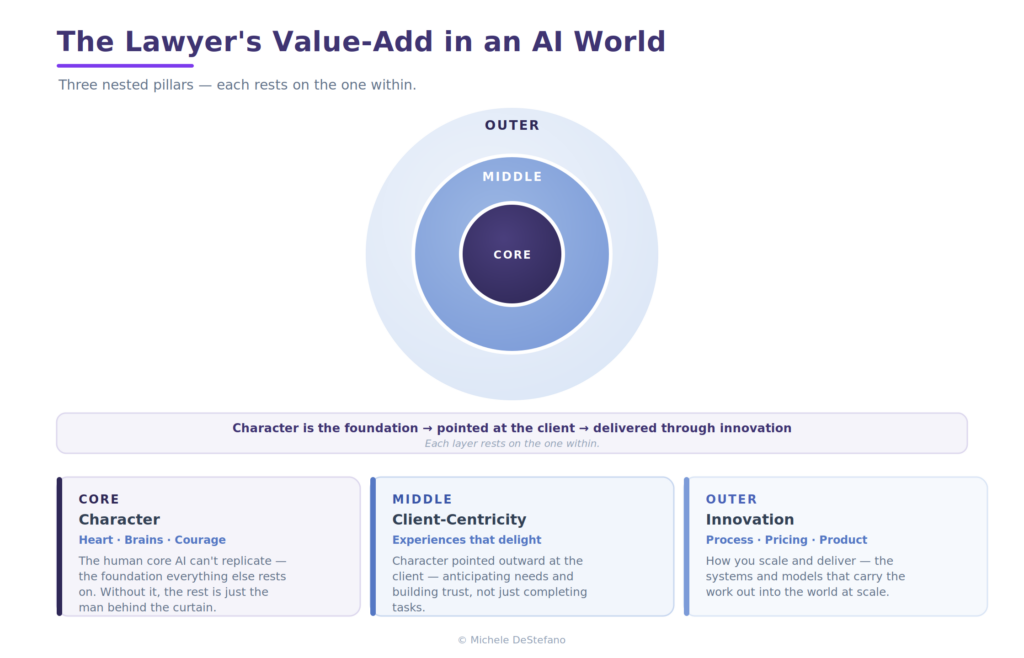
According to my research, these are the value-adds that make the difference, making the lawyer someone a client can’t imagine losing—no matter how good AI gets.
Value-Add One: Character
AI is an answer machine of astonishing power. But the value of a lawyer was never only in the answer. It was in the emotional intelligence to build trust and deliver hard truths in a way the decision-maker can actually hear—the heart. It was in knowing which questions to ask, which risks matter, and which risks to take—the brains. And it was in making the call (not just handing over options with risk assessments attached) and standing by it—the courage. Together, I call this character. I use the word deliberately: expertise is what a lawyer knows; character is who the lawyer is—and it is the one thing clients cannot download.
Character is having (1) the heart: the EQ skills to listen, communicate, and collaborate with empathy; (2) the brains: the judgment skills that require more than expertise; and (3) the courage to make the call and own the risk.
Think of The Wizard of Oz. The Scarecrow wants brains, the Tin Man a heart, the Lion courage—and Dorothy has all three, which is why she leads the way. The Wizard, by contrast, is a fraud: a small man behind a curtain projecting omniscience. For decades lawyers could be like the Wizard, the experts who were hired because they seemed to know more than the client ever could. As one of my interviewees, an M&A/private equity partner at a midsize NYC firm, explained, AI pulls back the curtain. “No longer can you be the Wizard of Oz. The client already did the research on ChatGPT.”
What remains valuable are the Dorothys: the humans who genuinely integrate heart (emotional intelligence, collaboration, and trust), brains (assessment, judgment, and discernment), and courage (the backbone to act and own the risk). In other words, character.
Heart: The tin-man
EQ is far more than warmth and perception. It is curiosity, communication, listening, and the ability to collaborate and build trust. These are the skills that turn a legal adviser into a true partner. The clearest proof that this is real value is that firms are starting to hire for it: “There’s more premium on EQ now. In the past you’d look at grades,” a managing partner at an Am Law 100 firm told me.
In particular, the “heart” skills the interviewees name are:
- Self-awareness. Knowing your own reactions and staying composed when clients most need a steady hand. As a CLO at a Fortune 500 tech company told me: “building up emotional awareness and control to manage crisis.”
- Curiosity and drive. The engine to keep learning and dig past the obvious question, repeatedly named as a hiring signal for an AI era. “Your level of curiosity matters,” one interviewee told me.
- Communication and listening. Framing the message so it lands and truly hearing what was asked.
- Empathy. Reading and genuinely caring about the client; this trumps technical brilliance. One partner said: “If I feel like you don’t care about me, rational or not, I will go. And your rational analysis is irrelevant.”
- Collaboration and partnering. Being one of the team, not an external counselor. A senior legal counsel at a multinational transport and infrastructure company explained it as: “STOP being just external counselors . . . I really want a law firm to be my business partner, sitting with me in a meeting.”
- Trust, humility, and authenticity. Being real and reliable enough that clients hand you the call. “I still go to Rob because I trust him—the human relationship is always there,” one interviewee said.
Brain: The scarecrow
The single most-cited value-add was brains—in other words, judgment, which is a mixture of discernment, context sensitivity, and knowing what to do, when, and how. As AI raises the floor on drafting, seasoned judgment becomes scarcer and more valuable, not less. The lawyer is the one who challenges and verifies AI output and holds the gray-area call. Unfortunately, junior lawyers, who lack the years of experience, can’t do any of those things. If AI displaces junior work and juniors lack judgment, this of course creates a pipeline problem.
As a senior legal innovation manager at a large international law firm explained: “You, as a law firm, have to be better than AI.” And one way they can be better is with judgment. One lawyer in pharmaceuticals was blunt about what he actually buys: “I need your DOJ expertise, not the rote work.” I heard it over and over from interviewees: The junior associates who can only “copy and paste without critical challenging” are whom AI replaces. The “senior people who challenge the tool” are who make themselves indispensable. As many interviewees explained, the lawyer “is becoming a verifier” whose checking, standards, and “surgical work” are the premium-value layer on top of AI.
Courage: The lion
Interview after interview made clear that judgment becomes valuable only when a human stands behind it. As one interviewee, a director of threat intelligence and security at a Fortune 500 financial technology company, explained: In an AI world, the law firm lawyers “take the liability instead of me.” That is what the client is buying. We want law firm partners who will “stop with the zero risk and doing everything by the book. It doesn’t work like that in the real world,” one in-house lawyer explained. Sometimes that means saying no or questioning the strategy. Done right, the lawyer’s pushback reads not as obstruction but as protection: “It tells me he is protecting me and the organization, not [just] slowing me down,” a global operations director at a Fortune 500 technology company said.
Where this value lives: The professional skills delta
If you want a map of where the value-add is migrating, here is one I created—the Professional Skills Delta.
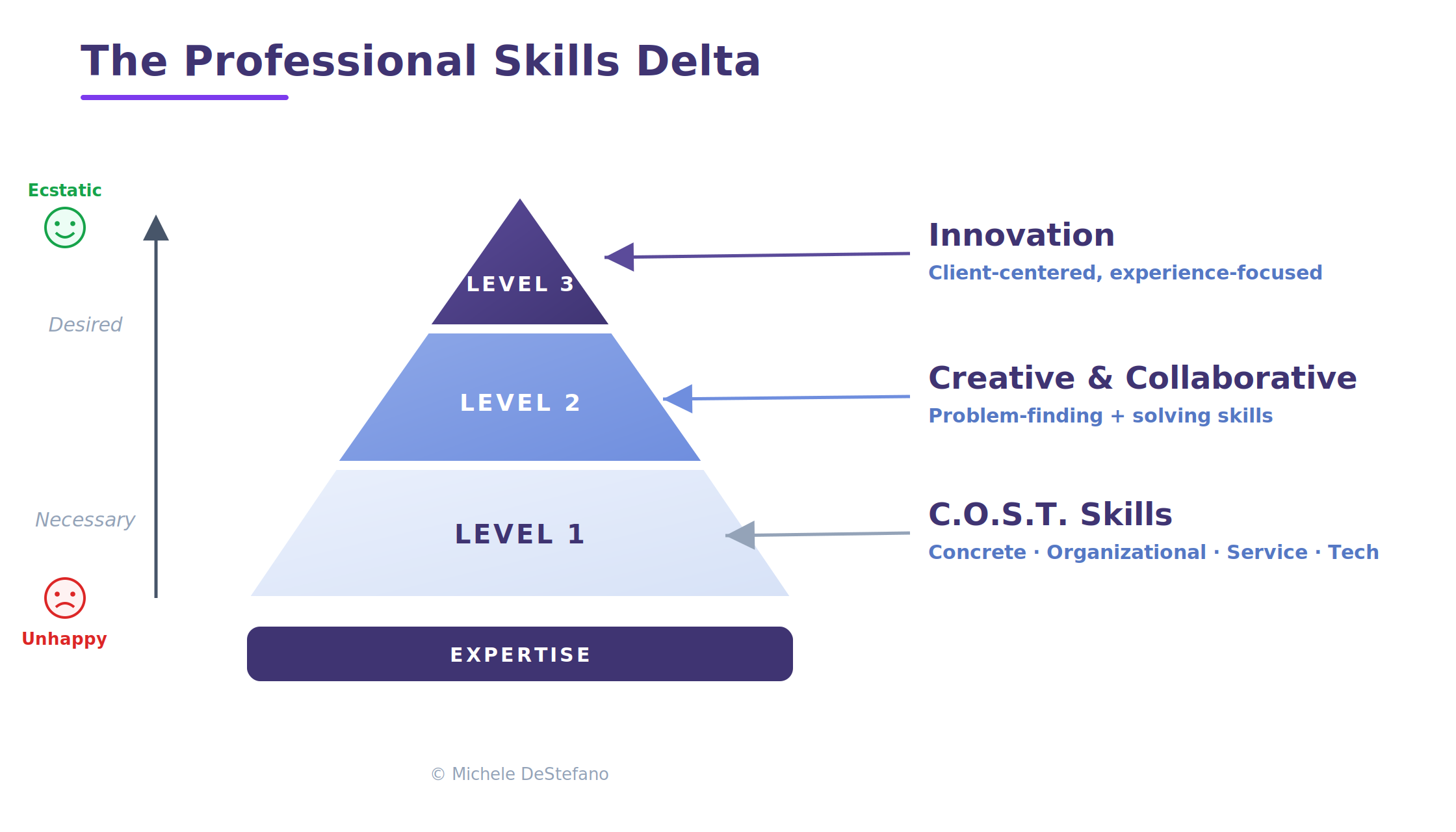
At the base sit the level 1 skills—concrete, organizational, service, and technical, including generative AI itself. They are necessary and are costly in terms of time to build. Level 2 skills are collaborative, creative, problem-finding, and problem-solving—being empathetic, curious, self-aware, humble, audacious, resilient, an active listener. Level 2 is where Character lies. As AI takes over expertise and level 1, the value-add moves up the pyramid.
So, the question for you and your team: Which two level 2 skills will you commit to bring every time you are part of a team—and which two will you build over the next four months?
Value-add two: client-centricity, or “as you wish”
A year or so ago I set out to answer a deceptively simple question: What do lawyers believe is meant by client-centricity?
I conducted 40 anonymous conversations with lawyers and the clients they serve—separate from the interview project for this article. I was also hired by the in-house legal department of a large international bank to interview its business clients and find out whether they thought their lawyers were client-centric. My interviews were eye-opening and, at times, hard to hear.
Here is what I realized: lawyers often conflate great service with client-centricity. Great service is important, but not the same. A partner at a large UK firm gave me his definition of great service: meeting expectations, hitting tough timelines, producing good-quality work, and offering a few client seminars. That’s a fine definition of great service but on a one-to-five scale, it’s a three for client-centricity. Working hard and avoiding mistakes is the floor, not the ceiling. Client-centricity requires authenticity and experience. It is something you can’t fake; clients feel it when you don’t mean it.
Based on 15 years leading hundreds of teams on innovation journeys, I believe the most successful lawyers are deeply client-centric, because they build products and services not as they think a client wishes but as they know the client wants.
If you’ve seen The Princess Bride, you may recall the farm boy, Westley, who answers every one of the demands made by the princess, Buttercup, with three words: “As you wish.” What he really means when he says this, the narrator says, is “I love you.” Wait! I’m definitely not suggesting your clients should fall in love with you; that would be its own kind of problem. But the spirit is exactly right. Kevin Doolan, who runs trusted-adviser workshops for law firm partners, puts the same truth in a line he was once accused of lifting from Hallmark: “I don’t care how much you know, until I know how much you care.” Serving clients in their language, in their format, the way they want it (text or email, long meetings or short, the small things), is the package around the expert advice you’ve worked so hard to develop. And based on my most recent set of interviews, in a world where AI increasingly handles much of the work, that package around the work is one way to differentiate.
Client-centricity is not about doing the work; it is about doing it the way the client wants—on their terms, with their data, and knowing their business, their risk tolerance, and how they like to receive advice. When AI levels the substance, the experience is the differentiator.
One client described one AI-forward firm that stood out: “I couldn’t tell they used AI. The attention they give us, the way they talk to us, the details they always tick off are the same as before AI.” With every other firm, she said, she can tell the moment they switch on AI. Not this one. It was clear that they had “a profile for each client, trained to our needs, the kinds of emails we prefer. Everything is tailored to us.” Her conclusion is the whole client-centricity value-add in a sentence: “If each firm has the same tools, I choose based on the attention to the customer.”
It’s like Burger King’s Have It Your Way tagline
The clients I interviewed kept describing the same thing in different words: know my business cold. A former GC in global financial services told me what wins her in a pitch: “a pleasant surprise at how much research they had done about my business, how we make money.” Another interviewee: “Highlight what you’ve done for similar banks; we want to know your culture knowledge, the commercials of the deal.” A third put it most vividly: “You live in the bunker—you need to understand the whole course, not just the fairway.”
The same theme kept coming through: be client-centric by doing it the client’s way, on the client’s terms, with the client’s data. This may seem obvious, but it is rarely practiced, which is exactly what makes it a differentiator.
Client-centricity is all about how you make your clients feel
Client-centricity is a practice, not a program. It’s the whole journey, not just the meeting. A lawyer friend once invited me to his new office and emailed me a map beforehand—a nice, client-centric touch since he knew I was logistically challenged. But he didn’t tell me about the parking lot that was closer than the one I parked in or that one elevator in his building was broken and the other reached only a floor that required yet another elevator down, then up. By the time I arrived, I was sweaty, frizzy, and furious—before we’d said a word. Client-centricity is every moment of the client’s journey to you, not just the moment they’re in front of you. It’s their needs and wants, not yours, and not what you assume they need and want.
Now contrast that with Costco. Music writer Bob Lefsetz described a single run to the warehouse: An employee roamed the checkout line with a handheld scanner and rang up his entire cart before he reached the register, so the actual checkout took two minutes. Then, out in the parking lot, he discovered the carts have rubber bumpers, so they can’t scratch your car. “They were doing every little thing to enhance the consumer experience,” he wrote. “They know me and want to keep me as a customer . . . they’re constantly innovating.” Client-centricity is every moment of the journey (for example, inside and outside the store). It is created for the client, and the client feels the difference. I have led workshops with hundreds of lawyers, and when asked to provide their definition of client-centricity, 90 percent never mentioned a feeling—even though client-centricity is all about the way you make the client feel.
Client-centricity is creating the experience each individual client wants, which can vary by person. One client wants the Ritz-Carlton; another wants the IKEA. In the bank project, the CLO learned from his internal clients that his legal team’s service felt more like a “Holiday Inn Express” than a “Ritz-Carlton,” and it stung! But it started the conversation.
If the farm boy, Westley, had served two princesses, each would have wanted something different. It’s as if to be client-centric we have to be mini magicians, making magic for each client, pulling rabbits, pigeons, or stuffed animals out of hats based on their preferences.
Listen at the level of empathy, and then actually do it.
Being client-centric is saying “yes, and” to their desires. It’s delivering an experience that delights for the things you commit to. If you can’t do something in a client-centric way, sometimes the client-centric answer is no.
Above all, client-centricity is not about anticipating a client’s needs and wants. It’s asking, listening, and then delivering. We often assume we already know what our clients want and how they want it—partly because, as lawyers, we are afraid to ask because we think we are supposed to know, and partly because we actually think we know. Psychologists call the latter “projected similarity”: I’m a window-seat person, so I can’t fathom why anyone would choose the aisle. (It’s roughly fifty-fifty, by the way.) We do the same with clients. We assume. Instead, we should ask—most of us never have. But beware: if you ask what they want and then don’t deliver, you will let them down. Listen at the level of empathy, and then actually do it.
How can you do this—and how might AI help? Shadow your clients and adopt their language. AI is great at helping you talk in their voice. Learn their mission and vision. Write their preferences down (which also serves as succession planning, so the relationship doesn’t collapse when you take leave or the department reorgs). Ask their preferred cadence, response time, meeting length, and channel. And measure the right things. As Gene Cornfield touts: track CPIs (customer performance indicators), not KPIs. Your KPIs are the metrics you invented; CPIs are the things your client cares about that you may know nothing about. Run a priority-alignment study, because the most common failure I find is misalignment: legal pouring excellence into things the business doesn’t care that much about while underdelivering on the things it cares most about.
In a world where AI can think like a lawyer and do things that a lawyer can do, the wrapping, the as-they-wish experience, is the differentiator.
Team exercise: Unpack your secret sauce
My great-grandmother Rose, a tiny Sicilian who couldn’t speak English or read or write, held every family recipe in her head: our acasada, escacha, and of course our Italian sauce! My very American mother used to chase her around the kitchen with measuring cups, trying to pin down a “tablespoon of this” while Rose threw in handfuls to ensure that when Rose passed, the recipes would not go with her. This is how many lawyers are about client-centricity. They may be naturally client-centric, but they’ve never unpacked their own recipe—which means they can’t teach it to the next generation, and their clients feel the loss every time an attorney leaves or the department reorgs. This exercise helps lawyers unpack their secret sauce. Do it with your team.
Step 1. Name it and describe it (individual, silent). First, write three real, specific examples of something that is not client-centric—something you, your team, or another team has done. No names. Be specific (“they don’t return calls the same day,” not “poor communication”). Then, write three real examples of something that is client-centric. Now, write your own definition of client-centricity (not using AI!). Lastly, share your examples (but not your definitions) with your team.
Step 2. Find the feeling (individual). Name a service experience you love—a hotel, a spa, Amazon, your car-repair shop, a babysitter. Give three reasons and, more importantly, three feelings explaining why. (My then-twelve-year-old son chose Subway: “They remember my name; it makes me feel special, known, like I belong. I can pick every part of my sandwich, which makes me feel important, listened to, like my preferences matter.”) A GC at an oil company picked her favorite hotel because she felt “surrounded by beauty, comfortable, and safe.”
Step 3. Define it together (small groups). As a group, review your original client-centricity definitions. Check to see if any of the original definitions included any feelings. Now, together, collaboratively write one shared definition of client-centricity—and be sure to put some feelings in it from step 2. This is where it gets interesting. Group writing is hard; if you can’t agree on every word, you have artificial harmony, not alignment.
Why this exercise works
It surfaces how differently the people on your team—especially juniors—define client-centricity; it forces lawyers to unpack the recipe they’ve never written down; and it reveals the missing ingredient (feelings) in most definitions.
Homework
For one week, notice when a service frustrates you (the 20-minute car wash that keeps upselling) and when it delights. Write down what the service provider did and how it made you feel. We are all clients; the fastest way to learn client-centricity is to pay attention to our own experience of it. Now tweak your definitions. Then, run them by your clients and revise based on their input.
Value-add three: innovation, or there’s a method in the madness
If character is the foundation and client-centricity is where you point it, innovation is how you deliver and scale both.
But let me start with what innovation is not, because in professional services we constantly get this wrong. We say the word and picture technology. That is exactly the wrong picture. The lawyers who impressed their clients in my interviews were never the ones with the flashiest tools.
The call for innovation is a call for two types of transformation
After interviewing hundreds of clients of professional service providers over the past decade, I’ve come to believe that when clients ask lawyers to “innovate,” they are asking for two things.
First, they are asking for transformation in service from their lawyers. What clients want—whether they say so or not—is for their lawyers to hone the mindset, skill set, and behaviors of innovators.
Second, in a world of AI, even more so than ever before, the call for innovation is also a call for the creation of new value. The lawyers who understand this don’t lead with tools; they co-collaborate with clients to rethink how the work itself gets done.
This was a common theme among interviewees: “We are maniacally focused on workflow, mapping 80 percent of work types onto the tools,” one partner told me. That is the real work of innovation: redesigning how the work flows through it.
Innovation isn’t an idea problem—it’s a marketing problem
Here is the line I keep coming back to: innovation isn’t an idea problem so much as a marketing problem. The bottleneck is rarely the idea; it’s getting people to believe in it, adopt it, and change how they work. My interviews say exactly the same thing. The firms winning ran change-management campaigns, not pilots. The firm with the highest adoption I found (82 percent) didn’t win on technology; it won on the campaign.
And where adoption stalls, it stalls on people, not on tools. One legal department leader found that off-the-shelf AI “saved an hour or two a week, but then interest in the tools quickly plateaued and progress stalled”; the real constraint was “this mindset shift [which] has been a significant obstacle to our making more progress.” The same leader is already rewriting who he hires: “We reward much more explicitly ingenuity, process optimization, openness to change, and adaptability.” In other words, the tools are necessary and nowhere near sufficient. The constraint is mindset and behavior—a marketing and management problem, not a technology one. This is why the first value-add was character and the second, client-centricity, all of which require this new mindset and behavior in order to fulfill.
What innovation actually looks like
The interviewees who impressed clients were not the ones with the shiniest tools; they were the ones rethinking how work is scoped, priced, and packaged. The frontier is moving from “services” toward productization.
“The firm of the future is a blend of products and services . . . products that are AI-driven,” a partner at an Am Law 100 firm told me. The pricing follows the redesign—and shares risks and rewards with clients. “You come in below [the original fee agreement], we share the savings 50/50—we price it the way our business prices to customers,” one interviewee said. For example, from another CLO, if “summary judgment [costs] $60,000 [to handle]—if the firm is successful, then we will pay $100,000.” And sometimes the redesign opens an entirely new market. One former CLO points to her firm’s platform that sells templates and self-help to clients who could never afford the hourly rate as a “transformative use of AI: creating a whole new market.”
AI and attorney-client privilege
Michele DeStefano explores a related concern in a new article, “AI and the Attorney-Client Privilege: Is AI a tool, representative, consultant, or team member?”
As the synopsis explores: Lawyers worldwide now routinely rely on generative AI platforms to analyze transactions, assess risk, draft documents, and shape legal advice. Only one federal case, United States v. Heppner, has addressed the question holding that documents a defendant generated using the public, open version of Claude were not protected under attorney-client privilege. But the ruling left open the harder question: whether privilege can be applied to lawyers’ interactions with generative AI tools that are closed and assure confidentiality i.e., tools that promise that they do not use or retain data to train the model and do not disclose data to others.
The real prize: creating new enterprise value—with the business
There is a deeper reason innovation belongs on this list, and it surfaced again and again from the in-house side: the most ambitious CLOs don’t want AI merely to do legal work faster; they want it to create new enterprise value—turning the legal department into an engine of savings and even revenue for the business. “The prize is the [data] brain,” one CLO at a global food company told me. He wants to tap into the company’s own data and risk tolerance to “build a better relationship with customers and more revenue and move faster to contract.” He is using AI to comb procurement contracts for the discounts and most-favored-nation pricing the company had agreed to but never collected. “If our spend today is $1 billion . . . there’s a $3 million in savings. [That’s] the value of knowing what you are supposed to get.” He is also using AI to renegotiate global customer deals by analyzing “where they were willing to pay more.” Another CLO is mining a 60,000-patent portfolio for the value AI can surface. With AI, he is “finding ways to add value on the IP portfolio . . . getting more out of the assets,” and probing entirely new pricing models for the company’s products. This is innovation as value creation, not cost-cutting.
Related content
event
Related content
Impactful Leadership
But that value gets captured only when legal builds the infrastructure and the teams to go get it. One CLO spent years turning his department’s scattered files into a structured, anonymized “data lake.” He is now requiring his two primary law firms to pool their data into a shared “collab hub” with his. He explained to those firms: “All the data you have is now ours.” And “when a new matter goes to either of those two firms, they have to first look at the database . . . they cannot go back to square one and bill me.” The firms “hated it; they fought it,” but he insisted, because the value lives in the data, and capturing it takes lawyers, technologists, and the business building together. The departments getting there put lawyers on cross-functional teams with “engineers who partner with our team” on procurement, expanding “from law into procurement, HR, and finance.” And the law firms that stay relevant will do the same. They will hone the mindsets and skill sets of innovators (like those on the Professional Skills Delta) and cocreate with the client instead of waiting to be handed a problem. As one in-house lawyer said she wants from her firms: “You are one of us: building the solutions andfighting with us.”
Where it all comes together
Like on my Professional Skills Delta, innovation sits at the very top—level 3. And without the other levels, without character and client-centricity, we will be just like the Wizard of Oz: a booming voice and a smoke machine, with no one of substance behind the curtain—when our goal is to become the Dorothy leading the way. When we do that—when we master the three value-adds in a world of AI—we ensure that if AI is replacing anyone, it isn’t us!
Michele DeStefano is a professor of law and the Larry Hoffman Greenberg Traurig Business of Law Chair at the University of Miami, visiting faculty at Harvard Law School, and a program chair and affiliated faculty of executive education at Harvard Law School. She is also the founder of LawWithoutWalls. She thanks Claude for help drafting. All errors are her own.