
In June 2026, 60 leading general counsel and senior legal operations leaders from companies around the United States came together at Harvard Law School to tackle a common but difficult question: How should general counsel approach integrating AI into the legal department, beyond simply driving adoption? What metrics and learning should legal departments track to understand actual and responsible impact? In the event “Moving from Adoption to Responsible Impact: The General Counsel’s Role in AI Governance, Cost, Quality, and Ethics,” hosted by the Harvard Law School Center on the Legal Profession and sponsored by Workday, four current-use AI use cases framed the day, as well as a group exercise to flesh out the metrics a legal department should track to demonstrate impact. The day concluded with a conversation between Enrique Colbert, general counsel at Wayfair, and Rich Sauer, chief legal officer and head of corporate affairs at Workday, to explore how two leading legal officers are thinking about AI in the workplace.
Governance and understanding value
“The future is here. Now what are we going to do about it?” asked David B. Wilkins, faculty director of the HLS Center on the Legal Profession and Lester Kissel Professor of Law at Harvard Law School. Wilkins opened the day with a timeline of AI advances in the past five years, starting with ChatGPT’s arrival in December 2020 to today, with every company now offering bespoke AI solutions for legal needs. From this context, the goal of the workshop, Wilkins said, was to work through three big challenges facing in-house teams:
- Efficiency and absorption: How are in-house teams tracking not just adoption but also the absorption of these tools into the day-to-day work of your teams and partners? How are organizations measuring the efficiency gains from using AI and in work done by external providers?
- Quality and judgment: How are companies assessing the relationship between these efficiency gains and the harder-to-measure—but arguably more important—impacts on legal judgment and the overall quality of legal advice and outcomes?
- Trust and accountability: How are teams measuring the impact of AI on trust in the legal function—for example, trust from clients, internal stakeholders, and regulators—and who within the legal team is accountable for monitoring professional independence and safeguarding that trust?
Wilkins was joined by Bjarne Tellmann, CEO at FjordStream Advisors and former general counsel at both Pearson and Haleon, who used the metaphor of driving on the Autobahn to discuss the “structured velocity” legal departments need to capture to excel today. The German Autobahn is famous for having sections with no speed limit—but it’s also one of the safest highway systems in the world because it has strict rules, engineering standards, and disciplined drivers. You can go fast, but only because the structure around you is excellent, Tellmann explained. He argued that high-performing legal teams need to balance two things that feel like opposites:
- Velocity: Moving fast, being responsive, enabling the business to act quickly rather than being a bottleneck
- Structure: Having clear processes, governance, risk frameworks, and guardrails that make that speed safe and sustainable
In Tellmann’s terms, governance is what makes scale safe and sustainable. The general counsel role, in turn, must evolve from a legal adviser to a strategic governor.
Reskilling for the future
In four use cases from Fortune 500 companies, senior in-house leadership discussed how they were embedding AI in their legal departments and the major lessons learned from those projects. A few takeaways:
- Upskilling and reskilling. All four use cases highlighted the need for reskilling and upskilling employees rather than substituting AI for employees, as well as using AI to help with repetitive, administrative, or high-volume work. Professionals could then concentrate on judgment, strategy, edge cases, client relationships, and complex problem-solving. But, the use cases also noted that this was easier said than done. Moving from adoption to fluency continues to be a challenge.
- Compliance and due diligence. For companies with regulatory hurdles, AI was useful for tracking global regulations and reporting. Crucially, AI has been helpful in transforming legal departments in this arena from reactive to proactive creators of value.
- Data and governance. All four use cases noted the dangers of “garbage data = garbage AI.” Some teams already had quality structures in place, while others had to create new streamlined processes for what data entered their tools. One company working with wide data sprawl implemented an AI content council, with AI working groups owning each agent and ensuring that only governed sources could feed agents. Crucially, implementing AI in this way has created new roles on the team—like AI content curator and agent lead. Governance also meant human oversight—teams relied on testing, antifabrication rules, and mandatory human review before any AI output was used.
- Guidance from the top. Companies with mandates from C-suite leadership were more successful in integrating AI into their legal department, from both strategic as well as cultural standpoints. Adoption required managing skeptics (often through internal storytelling and showcasing concrete wins), and having leadership buy-in was critical.
- Cost and the role of outside counsel. Across the cases, AI delivered substantial time and cost savings that freed teams for higher-value work—from generating strong first drafts at a tiny fraction of associate time, to contract and compliance reviews that compressed thousands of hours into minutes. These efficiency gains pushed companies to rethink outside-counsel spend: doing more in-house, scrutinizing where external firms add value, and, where appropriate, shifting toward alternative fee arrangements. The economics of legal work—what gets done internally versus externally, and how firms are paid—is being actively renegotiated as a result. The cases also stressed collaboration with external providers, including law firms, on data, training, and governance—though they differed on what law firms should, or could, do with that information.
Preliminary survey and experiment
At the workshop, the Center launched a new research project examining a question that has become one of the hardest in the legal industry: not whether in-house teams are adopting AI, but how to measure absorption and impact. Anchored by a new survey of general counsel and senior in-house leaders, the project traces the legal function’s path:
- From adoption: Are people using the tools?
- To absorption: Are teams incorporating the tools into their workflows in real ways and is the work itself changing?
- To responsible impact: Is that change delivering measured, accountable value?
A preliminary reading of workshop participants suggests that many departments are still stuck near the starting line. As case in point, less than 5 percent of legal departments said they measure AI using “systemic output metrics,” such as around quality and cost. Around a half reported tracking an ad hoc mix of outputs and adoption metrics. Twenty-two percent reported tracking no quarter metrics at all.
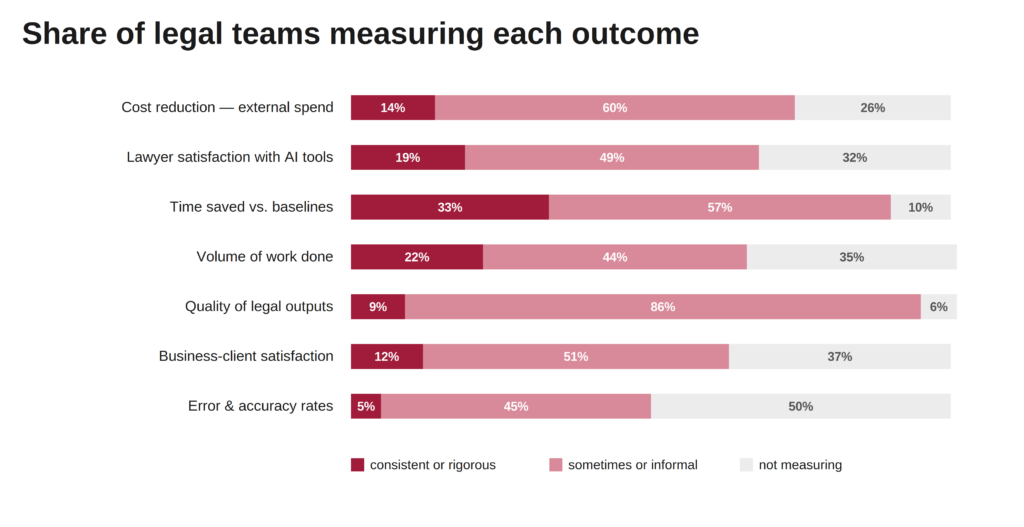
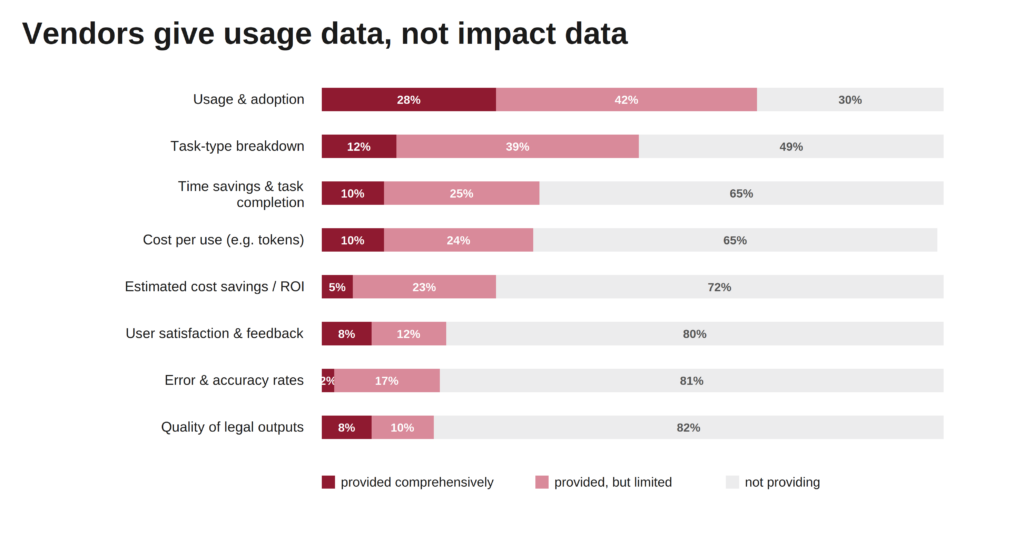
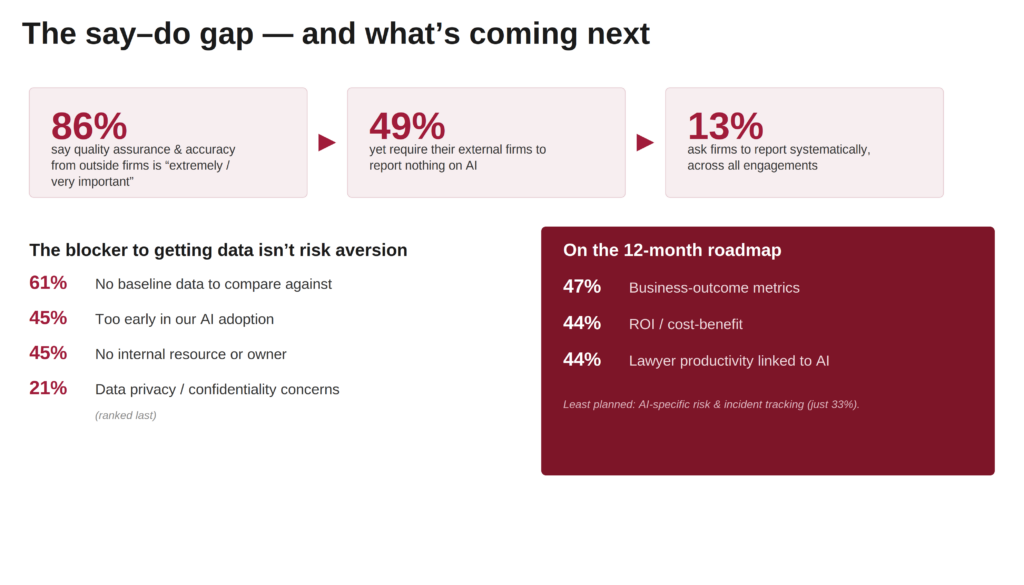
Rigorous measurement was scarce across every outcome surveyed—from reductions in external spend and time saved against baselines to lawyer satisfaction, quality of legal outputs, and business-client satisfaction—and fully half of teams don’t track error and accuracy rates at all. Vendors, meanwhile, supply plenty of usage data but little beyond that, with around three-quarters receiving nothing comprehensive on ROI, quality, accuracy, or satisfaction. Human review still remains critical, with about half relying on senior-lawyer review.Many companies are clearly still figuring out how to deploy responsible AI, but across companies surveyed, many are looking at legal as important decision-makers, placing legal on formal AI governance committees. Still, the most common answer for who owns measuring AI’s impact is “no single owner,” and while 86 percent call quality and accuracy from outside firms important, nearly half do not require their firms to report on AI use—the top obstacle being the simple absence of baseline data to measure against, not privacy or risk.
Many companies are clearly still figuring out how to deploy responsible AI, but across companies surveyed, many are looking at legal as important decision-makers, placing legal on formal AI governance committees. Still, the most common answer for who owns measuring AI’s impact is “no single owner,” and while 86 percent call quality and accuracy from outside firms important, nearly half do not require their firms to report on AI use—the top obstacle being the simple absence of baseline data to measure against, not privacy or risk.
Putting the group to work
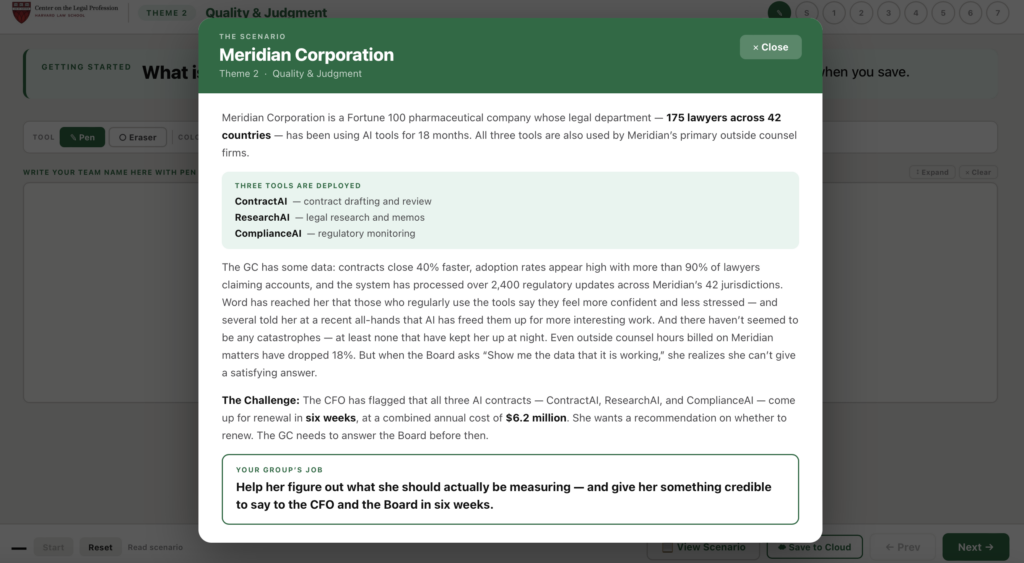
As part of the workshop, participants worked through a relatable scenario: a pharmaceutical company that had been using AI for 18 months across three areas (contract drafting and review, regulatory monitoring, and legal research). Suddenly, the CFO was demanding answers: Is AI having an impact? How do we know? Groups worked through seven structured steps: from critiquing what the data didn’t tell them, through identifying what should actually be measured and where they were flying blind, to committing to one concrete metric they would implement in the next 90 days. Groups considered three themes—Efficiency and Absorption, Quality and Judgment, and Trust and Accountability.
Across all eight groups, one big takeaway emerged: everyone was concerned about how skills might atrophy, regardless of theme. Groups used different language, but the concern remained: optimizing for AI creates a structural training gap in the legal profession.
AI and the legal profession
What the exercise revealed is how much still must be decided. Professionals, Wilkins observed, tend to assume that a new technology will simply let them do what they already do—only faster and more cheaply. Far more often, he argued, it redefines what it means to be a professional in the first place. For lawyers, in his telling, that redefinition arrives on favorable terms: law has become central to virtually every part of business, even if rarely in any clear or consistent way—a kind of gateway drug, as he put it, into the problems that matter most. But centrality is not sufficiency. Law will only ever be one part of those problems, Wilkins cautioned, and frequently not the most important part; the discipline the moment demands is learning not to grow addicted to law or to hook clients or society on expressly legal solutions. What it means to be a lawyer, in other words, is being remade, and meeting these problems will require the profession to equip lawyers with new skills and new sensibilities, beginning, at a minimum, in law school.
To further explore these issues, Wilkins and the Center have launched a new project in collaboration with Anthea Roberts, a professor at Australian National University and the founder of Dragonfly Thinking, called AI, Complex Decision-Making, and the Future of the Legal Profession. It begins with three propositions:
- AI will structurally reconfigure how legal services are delivered, who delivers them, how lawyers are trained, and what it means to exercise professional judgment.
- Even as it automates many legal tasks, it will open new ways for lawyers to add value on the increasingly complex problems facing clients and society.
- Realizing that potential will require a deep understanding of both the technology and the structures and practices of lawyers.
The project’s work is now gathered on a new website with a series of essays and interactive visualizations, including a topic network that maps the project’s underlying knowledge base of 170 sources across 39 topics and 11 dimensions. The pieces are shared as they are drafted, the authors note, “not as finished pronouncements but as lenses being tested and refined.” Three of them take different cuts at the same landscape:
- “Law is the gateway drug” contends that law’s position at the center of business—connected to every other function—makes it the natural entry point for AI across professional services and asks whether law captures that gateway or the gateway captures law.
- “The Scrambled Competitive Map“ charts the terrain AI is redrawing, as incumbents, challengers, and clients each exert their own pull on a market in which old boundaries no longer hold.
- “Getting your hands dirty” turns from analyzing the system to working inside it, asking what it actually feels like to think alongside AI agents on complex tasks—and why the distance between discussing AI and using it matters more than most acknowledge.
No single group works this out alone. It will take a partnership—legal academics and practitioners on every side of the market: in-house counsel and the companies they serve, law firms, the alternative and technology providers now competing with them, and the institutions that train the next generation. This workshop was one part of that conversation.
Image credit: Shutterstock // MAFPHOTOART8