
What does a professional do after board discipline? Often his or her only option is to serve as a doctor or lawyer to the poor, incarcerated, or addicted.
The following is an excerpt from The Licensing Racket: How We Decide Who is Allowed to Work and Why It Goes Wrong.
When [Dr. Michael] LaPaglia got the first round of discipline on his Tennessee medical license—his 2014 order placing his license on probation based on his state charges for dealing prescription drugs out of his home—it made working in the mainstream of medical practice impossible. At his disciplinary hearing in July 2019, where I first met Dr. LaPaglia, his lawyer told the board that it was difficult for doctors under disciplinary orders to find employment. “It’s a trap, it’s a conundrum,” he said. Dr. LaPaglia, he explained, “can’t get onto the insurance panels, no employer will touch him.”1
The Invisible Hand
Board members aren’t wrong when they point out that any disciplinary measure can have serious consequences for a provider’s career. It doesn’t look good with potential employers or clients to have a dent in your record, and there are ways someone might find out if they knew where to look. Individual states and boards have varying degrees of transparency; for the health-related boards in Tennessee, you can search a state-maintained database for a provider’s name and learn about public discipline.2 Tennessee maintains a similar website for lawyers, but not for professionals like accountants, funeral directors, and real estate agents.3
The Licensing Racket: How We Decide Who Is Allowed to Work, and Why It Goes Wrong (Harvard University Press 2025)
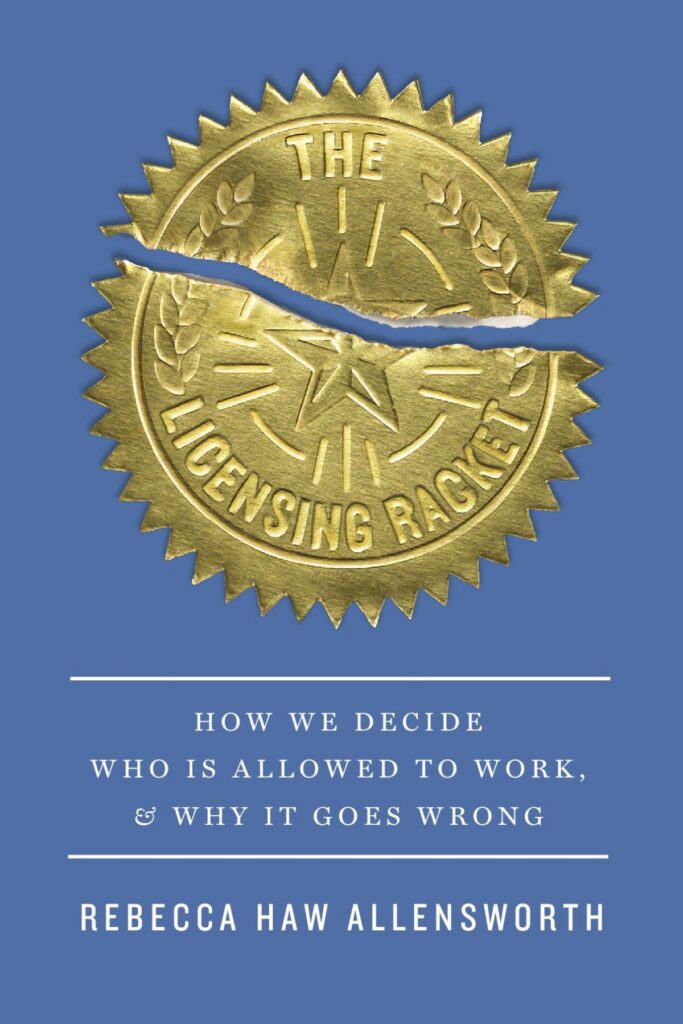 A bottom-up investigation of the broken system of professional licensing, affecting everyone from hairdressers and morticians to doctors, lawyers, real estate agents, and those who rely on their services.
Tens of millions of US workers are required by law to have a license to do their jobs—about twice as many as are in unions. The requirements are set by over 1,500 industry-specific licensing boards, staffed mainly by volunteers from the industries they regulate. These boards have enormous power to shape the economy and the lives of individuals. As consumers, we rely on licensing boards to maintain standards of hygiene, skill, and ethics. But their decisions can be maddeningly arbitrary, creating unnecessary barriers to work. And where boards could be useful, curbing harms and ensuring professionalism, their performance is profoundly disappointing.
Excerpted from THE LICENSING RACKET: HOW WE DECIDE WHO IS ALLOWED TO WORK AND WHY IT GOES WRONG by Rebecca Haw Allensworth, published by Harvard University Press. Copyright © 2025 by Rebecca Haw Allensworth. Used by permission. All rights reserved.
But even the most transparent of online databases are useful only to patients and clients who know about them and think to look up a provider. Many consumers believe that the licensing system obviates this kind of research—if you can practice legally, you must be relatively clean. As my spreadsheet of lightly disciplined bad actors grew, I realized this wasn’t true. Still, few consumers know to look up a provider’s disciplinary history. Of course, patients and clients aren’t the only ones interested in a professional’s history; employers want to know about licensure issues and are more savvy than consumers about doing their due diligence. But, with potentially fifty different state records to search, even large organizations can struggle to learn the relevant licensure information. Professionals with disciplinary records can take advantage of these gaps of information by practicing in another state on a clean license, or even seeking a new license from a board who may not know—or doesn’t care to learn—about the professional’s disciplinary history. This problem is especially well-documented in medicine, and it was a phenomenon I observed frequently in Tennessee.4
In the healthcare professions, this problem has been partially solved by the National Practitioner Data Bank (commonly known as the Data Bank), which was created by Congress in 1986.5 The Data Bank lists public state board discipline for the nation’s healthcare practitioners along with hospital discipline and major malpractice lawsuits the provider has lost or settled.6 It’s an indispensable tool for hospitals in making employment decisions and for insurance companies in deciding whom to include as covered providers. In theory, licensing boards can use it—for a fee—to keep tabs on their licensees’ malpractice activity and out-of-state board discipline, but very few use it more than sporadically (only three boards pay the extra $2 per licensee for the Data Bank’s “continuous query” feature that proactively informs subscribers of new information).7 Provider-level information from the Data Bank is inaccessible to anyone else, including patients, journalists, and observers like me.8 When Congress tried to open the database to the public, the AMA “crushed it like a bug.”9
The disciplinary process is supposed to take out the lemons and leave the peaches—to place a floor on professional practice so that everyone, even the poorest client or patient, gets someone who meets a minimum competency and ethical threshold.
The transparency (such as it is) afforded by board discipline databases like the Data Bank creates a sorting mechanism where practitioners with serious disciplinary histories sift down to the bottom of professional practice. This is how free-market capitalism works: buyers (in this case, employers), with reasonably adequate information (thanks to the Data Bank), find sellers (professionals) offering something fitting their budget. The better employers offering higher salaries and more prestigious gigs get the best professionals, while employers that are budget-constrained, rural, or are otherwise less attractive places to work, get the rest.
Adam Smith called this the “invisible hand” of capitalism—the force that, as if by magic, matches buyers and sellers and sorts everything according to quality and willingness to pay.10 But licensing is meant to soften the harsher effects of a capitalistic market for professional services. The disciplinary process is supposed to take out the lemons and leave the peaches—to place a floor on professional practice so that everyone, even the poorest client or patient, gets someone who meets a minimum competency and ethical threshold. As I describe how the invisible hand works on the market for professionals, ask yourself whether licensing’s promise to protect the public is fulfilled by a system that doesn’t remove the most problematic providers, but rather shuffles them to the bottom of the barrel of professional practice.
Down but Not Out
Different hospitals react differently to learning that a professional has a record in the Data Bank; the invisible hand works at the hospital level, too. Healthcare economist David Hyman and his co-authors studied the link between board discipline and hospital employment in Illinois and found that there were a handful of hospitals that had very high percentages of disciplined doctors, suggesting that they “either ignore [Data Bank] information or may even target [disciplined] physicians for recruitment.”11 Professor Hyman told me that one likely explanation was that these may be “hospitals of last resort . . . the last stop on the line” for problematic doctors.12 Even if a doctor manages to hold on to his hospital job, he may have trouble staying on an insurance panel. Insurance companies, too, track Data Bank activity, and most retain the contractual right to remove disciplined doctors from their rolls. Whether they do so comes down to how large a stream of revenue they provide to the insurance company and whether they are seen as being replaceable.13
Losing the ability to take private insurance or work at a hospital starts a doctor down a slippery slope. To better understand medical practice outside of the mainstream, I spoke with Luke Steinbach, the lawyer who represented Dr. Owens [an OBGYN from Memphis who admitted to having had sex with eleven patients and prescribing them large quantities of drugs without documentation] and Dr. Orusa [a pill mill prescriber] in their medical board disciplinary proceedings. Steinbach has made a niche practice out of representing doctors and nurses facing board discipline, and he is the only person I’ve met who makes a regular practice out of checking the disciplinary history of his and his kids’ doctors in the state database.13
At this particular point on the slippery slope, where private, prestigious employers are off the table, a professional that’s been disciplined still has a few options.
Steinbach told me that losing hospital privileges or being removed from an insurance panel makes a provider less attractive to partners. So does another collateral consequence, at least in Tennessee, of a probated license: the inability to supervise mid-levels.14 Mid-levels like physician assistants and nurse practitioners are often referred to as “extenders” because they multiply the number of patients a given physician can bring through a practice. To a practice group, a physician that can’t take private insurance, supervise mid-levels, or share in the hospital work is dead weight. Steinbach told me that discipline can get you kicked out of your group and can make joining one al- most impossible.15
At this particular point on the slippery slope, where private, prestigious employers are off the table, a professional that’s been disciplined still has a few options. Public institutional employers can be an option for a professional with some disciplinary history. Many public providers of professional services have some combination of features that make attracting top-notch professionals difficult: remote geography, high-risk populations, and publicly funded wages that fall short of those in the private sector. But they have something special to offer a troubled provider. Because these institutions can self-insure, they can offer employment to providers whose disciplinary history makes it hard for them to get private malpractice insurance.16 These employers may feel that having some tolerance for board discipline is the only way to keep their hospitals staffed or to provide constitutionally required criminal representation.
In the medical context, federal insurance programs like Medicaid and Medicare tend to have a lower threshold than private insurance for accepting providers with serious discipline. (Professor Hyman’s study found that the Illinois hospitals with the highest percentage of disciplined doctors also had high numbers of Medicaid patients.)17 Medicaid’s already low standard can be troublingly flexible. For example, an investigation in 2018 by the Milwaukee Journal Sentinel revealed that more than two hundred doctors remained on Medicaid rolls despite licensure history that should disqualify them according to federal rules. In 2015 alone, these doctors billed taxpayers $25.8 million.18
Likewise, the US Department of Veterans Affairs has faced a similar scandal for violating its own policy of not hiring physicians with a revoked license in any state. USA Today reported in 2017 that the Iowa City VA hired John Henry Schneider, a neurosurgeon with a long history of malpractice and wrongful death suits involving misplaced screws and devices, undiagnosed infections, and repeated surgeries to correct prior surgical mistakes. The Wisconsin medical board took action when, on top of the mounting evidence of surgical incompetence, Dr. Schneider killed a patient by prescribing him fentanyl, oxycodone, Valium, and Demerol. Wisconsin revoked his license, but his license in Montana remained intact, allowing for a fresh start at the Iowa City VA, where he went on to perform more botched surgeries before resigning when the illegality of his hiring came to light.19
In law, criminal courts responsible for appointing defense attorneys to represent indigent clients may be more open-minded about an attorney’s licensure file than, say, a white-shoe law firm.
There are other employers who might offer a disciplined provider a second chance. For example, jails and prisons are especially likely to hire a provider with a checkered past. One in five doctors employed by Georgia’s public prisons has serious discipline in his licensing history, making a prison doctor eight times more likely to have been disciplined than the average Georgia physician.20 American Indian reservations, too, seem to attract providers with disciplinary histories. In 2019, the Wall Street Journal ran a story about medical malpractice at Indian Health Service facilities. Many of the doctors involved in questionable care had previous board discipline; their offenses ranged from sexual abuse to unlawful prescribing. Some were hired despite IHS policy requiring unrestricted licenses.21 When I asked Steinbach where his clients go to work after the conclusion of their disciplinary case, American Indian reservations were high on the list.13
Other professions have their own version of the institutional employer with high tolerance for board discipline. In law, criminal courts responsible for appointing defense attorneys to represent indigent clients may be more open-minded about an attorney’s licensure file than, say, a white-shoe law firm. The court-appointment process stems in part from a 1963 Supreme Court opinion called Gideon v. Wainwright,22 which recognized a constitutional right to a defense attorney for all criminal defendants—even those who could not afford one. Most states responded by creating or expanding public defender offices in their major cities, the best of which view indigent defense as a fully professionalized calling. They train, supervise, and hold their attorneys to account. But these public defenders’ offices cannot handle all criminal cases with indigent defendants because of conflicts of interest, resource constraints, and geography. A lot of indigent criminal defense, especially in rural areas, falls on court-appointed lawyers paid out of state coffers. The pay rate varies among states, ranging from below-market to abysmally below-market.23
Systematic studies of disciplinary rates among court-appointed defense attorneys are rare, but the example of Maine suggests that appointed lawyers may be more likely than others to have checkered pasts. Maine is the only state that does not have any public defender offices—all indigent defense is provided through what amounts to an appointment system. ProPublica reported that appointed lawyers account for just 15 percent of the attorneys in the state but represent more than a quarter of the state’s attorneys who have faced major discipline in the last ten years.24
ProPublica’s investigation revealed breaches of professional conduct that ran the gamut from helping clients commit crimes to indecent exposure. One appointed defense lawyer convicted of possessing child pornography was denied access to the jails because of his criminal history, a problem that he addressed by representing only clients out on bond while “simply hoping” none of them got rearrested. Law professor Bob Cummins said of the system in Maine: “We’re allocating the indigent criminal work to individuals who are already in that class of lawyers who too often get in trouble.”25
Related content
Lead Article
Related content
A Higher Bar
Studies of death row inmates and their lawyers also paint a dark picture of indigent defense at the bottom of the barrel. Journalists found that nearly one in five Pennsylvania defendants sentenced to death in the last ten years were represented by an attorney who had been disciplined for professional misconduct at some point in his or her career. In 58 percent of the cases, the discipline had preceded the capital representation, and in 45 percent of the cases the attorney had been disciplined more than once.26
Indigent criminal defendants can make attractive victims for predatory lawyers, not only because they have no choice in who represents them but also because they are often in dire straits when the attorney-client relationship begins. For example, two of the victims of Gerald Moothart, an attorney who kept his license after sexually abusing several clients, were women he was appointed to represent because they could not afford an attorney. One said she acquiesced to his request for oral sex because she feared the consequences of saying no. “I was in a pretty tough situation,” she said. “[I was] going to lose my kids.”27
The Employer of Last Resort
Sometimes discipline is so serious that even institutional employment is out of reach. This was the trap Dr. Lapaglia’s lawyer referred to at his board hearing, the place where “no employer will touch him.” Here, a professional with a valid but tainted license has to turn to the employer of last resort: himself.
Recent empirical evidence of how discipline affects employment reveals that indeed discipline tends to shunt providers toward solo practice. A recent study of the labor market for attorneys finds that public discipline makes it harder for an attorney to stay at a firm, and makes it more likely they will turn to solo practice. The study finds that 12 percent of solo practice lawyers with a disciplinary record moved into solo practice after discipline, where they are most likely to serve the under- served, such as immigrants, personal injury victims and, of course, indigent defendants.28
Related content
Lead Article
Related content
Practice-Ready Licensing
Perhaps it’s not a coincidence, then, that solo practitioners make up a significantly higher percentage of lawyers and doctors who have been disciplined.29 Although there are alternate explanations for this phenomenon, including board bias against rural and solo practice, one likely explanation is that there actually are more troubled lawyers and doctors in solo practice than in group settings.30 A disciplinary focus on solo and small practice professionals may make sense if it’s where the disciplinary system itself puts professionals more likely to break the rules.
Cash-based solo practice, in medicine and law, is unaccountable to almost anyone but the state licensing board. There is no health insurance auditor to come inspect your clinic. There is no hospital peer review panel to weigh in on a case gone wrong. There is no senior partner to supervise your legal strategy for defending a capital murder case. And cash-based solo practitioners—whether the country doctor serving the uninsured or the lawyer eking a living out of court-appointment fees—tend to serve a clientele that is disproportionately poor, unsophisticated, and, especially in the case of incarcerated defendants, uniquely vulnerable. It is not, to say the least, a good place to park providers with a troubling history of professional discipline. To make matters worse, whatever temptations the fallen professional had to cut corners before her fall are even more intense at the bottom of the market. Non-elite solo practitioners make money by handling high volumes of cases or patients. The lower the pay, the higher the volume required to make ends meet.
The phenomenon of the professional mill is not unique to medicine. Some lawyers, especially outside of the large firms, are also paid by the piece—$1,000 for a DUI defense; $450 for an uncontested divorce.
Understanding the economics of solo practice requires distinguishing between professionals paid by the hour and those paid a flat fee for a service. Hourly pay, while prevalent in many professions, has a big draw-back: it creates the temptation to work slowly and inefficiently to run up a client’s bill. In some contexts, therefore, professions have settled on a model of fee-for-service; medicine has especially embraced this solution. A medical board member told me his wife liked to kid him, “you’re a well-respected garment worker; you’re paid by the piece!”31 She’s right; doctors at all tiers of practice are commonly paid by the procedure whether as a reimbursement from an insurance provider or directly by the patient. Pay-per-service fee structures solve the problem of slow-walking service and running up hourly bills, but they introduce the opposite problem of rushed professional work. In medicine, the pressure that pay-per-service has put on doctors to spend less time with their patients is well-documented.32
Dr. Anna Lembke, in her book Drug Dealer, MD, says the “Toyotaization of Healthcare”—the strive for healthcare efficiency as measured by patients seen per day—bears some of the blame for the opioid crisis. In a world where doctors are paid by the appointment, it is faster and cheaper to write a prescription than to explore other modalities of pain management or, what may be even more time-consuming, to confront or resist a drug-seeking patient. “Treat ’em and street ’em” is the best way to maximize reimbursements, a mentality that pushed the prescription pad to the fore of medical practice, to the ultimate detriment of public health.33
Though the problem pervades all strata of medical practice, it’s particularly acute in capacity-constrained settings where reimbursement rates are low and the demand for prescriptions is high. That perfectly describes a solo practitioner serving the underserved. When a country doctor takes it a little too far, we call it a pill mill.
The phenomenon of the professional mill is not unique to medicine. Some lawyers, especially outside of the large firms, are also paid by the piece—$1,000 for a DUI defense; $450 for an uncontested divorce. Here, the incentives tempt lawyers to move volume through their practice by taking shortcuts. Similar incentives are found among court-appointed lawyers in criminal cases. Although states ostensibly pay these lawyers an hourly wage, many have caps on how much a lawyer can claim for each case in total. These caps have the effect of turning an hourly system into a pay-by-the-case arrangement.34 Thus the appointed lawyers’ tendency to “meet ’em and plead ’em,” which has led many an innocent defendant to take a conviction based on weak proof.35
The incentive to rush—to turn quickly to a prescription pad or a plea deal—becomes even stronger as you descend the totem pole of professional service and the pay rates get lower. A doctor taking only Medicaid patients has to somehow find a way to support a practice on $50 a visit. And a defense lawyer to the indigent has to find a way to defend a murder charge—which can take years of investigation and litigation when done properly—for a single $3,000 fee from the state.36 For professionals serving the poor, cutting corners isn’t just a temptation. It’s virtually required by the system.
The Professional Caste System
Many would argue that, however unfortunate, the fact that the poor and vulnerable get inferior professional providers is inevitable in a market-based system. Poor clients and patients can’t afford to pay for long appointments, hours of investigation and advocacy or, in the case of pain treatment, fancy alternative modalities. So they get what they pay for (or don’t): a quick plea deal or an opioid prescription. Until we have fully public systems for the provision of professional services, we have to accept that people who can’t pay will get less.
Whatever wisdom there is in our system of using markets to allocate professional services (and whether there is any wisdom to it is beyond the scope of this book), professional licensing is supposed to protect the public from the worst providers that might haunt the lowest tranche of an unregulated market. Not only is the disciplinary system failing to weed out the bad seeds, but by slapping wrists without taking licenses, it’s pushing the most problematic providers toward the most needy populations. Licensing boards’ light disciplinary touch creates a self-reinforcing caste system of professional service. Whether board members understand this phenomenon isn’t entirely clear.
Most board members seemed unaware of the effect their light disciplinary touch had on at-risk patients and clients. It seemed inconceivable to board members—whose high-achieving professional career depended on things like hospital privileges, insurance credentials, and a rock-solid reputation—that there is a professional substratum where a different kind of provider can survive.
Although board members didn’t directly acknowledge their role in the professional caste system, I did observe some troubling indifference to the problem. After the hearing where the medical board relicensed Dr. Owens, a public member of the board (who had voted along with most of the doctors in favor of relicensure) remarked: “I wouldn’t send my daughter to see him.” A physician member reassured her that the Memphis OBGYN “only sees TennCare patients.” That fit with an argument in favor of relicensure that a different board member had offered at the hearing: that his victims were not “your friends and neighbors.” That board member told me later what she meant—that the patients were prostitutes.37
Boards limit the supply of providers with entry and ethics rules, all in the name of minimum competency, and then fail to hold the line against unethical and incompetent providers, allowing market forces to shunt these providers toward the patients and clients most harmed by the very scarcity they created in the first place.
Whether board members are clueless or indifferent about the caste system they perpetuate, it is wrapped up in something they do talk a lot about, if only in disciplinary cases: prioritizing access to care. Provider shortages are rarely addressed by boards working the ratchet or defending turf but make for a compelling consideration when boards take a light disciplinary touch. Many board members I interviewed about discipline cited this as a good reason for second chances. In protecting the people of the state, they told me, you have to consider the patients of an accused provider who would have to go without.
There is a certain logic to this argument. But together with the reality that the problem doctors tend to drift toward the neediest patients and clients, it endorses a double standard in professional competence and ethics—one for those who serve the privileged, and one for those who serve the poor. As a former executive director of the Mississippi medical board told me, boards in disciplinary cases seem to think “[any] physician is better than no physician,” even one with major ethical or competency problems.38 And board members seemed blind to the hypocrisy at the heart of their own regulation. Boards limit the supply of providers with entry and ethics rules, all in the name of minimum competency, and then fail to hold the line against unethical and incompetent providers, allowing market forces to shunt these providers toward the patients and clients most harmed by the very scarcity they created in the first place.
I saw a lot of providers accused of misconduct use their at-risk patients and clients to advocate for a lighter disciplinary touch, and it usually worked. Dr. Owens was a good example. Steinbach pointedly mentioned at his hearing that the doctor saw mainly at-risk, inner-city Black mothers. After his hearing, when I asked Dr. Owens why he thought he got his license back, he told me: “OBGYNs don’t grow on trees.”39
In states with large, underserved rural populations, the argument is particularly persuasive to licensing boards.40 When reporters for the Atlanta Journal Constitution confronted the executive director of the Georgia medical board about their findings—that most sexually abusive doctors in the state return to practice—he cited access to care as a reason for putting them back in practice. He pointed out that many patients in the state are desperate for care. “You do not think so? Then leave Atlanta and go down to a little Georgia town and get sick,” he said. “See how far they have to go to find a doctor.”41
In my own state, I saw the small-town argument work, too. One example was Dr. Carl Samuelson, whom I saw appear in front of the medical board for the third time for over-prescribing opioids. Despite the board’s lingering concerns about his prescribing habits, it reinstated his ability to prescribe, in part because he said his clinic provided care to the underserved. “Fifty percent of our patients are unemployed and below poverty,” he told the board. Full restoration of his prescribing ability was essential to the success of his clinic, he explained, because his only partner was also under board discipline for over-prescribing and had lost his DEA number.42
This line of argument was troubling enough when accused providers used it to invoke access-to-care issues. But sometimes it seemed to have an even darker purpose: to reassure the board that the troubled provider would stay out of the upper echelons of professional practice, where they might encounter the “friends and neighbors” of the board who are the proper focus of licensing’s protection. For example, when I saw particularly troubled physicians appear before the medical board—such as a psychiatrist who failed her licensing and specialty board exams three times each, or the sex addict who dismissed a patient in order to pursue an affair with her—bewildered board members would ask where the physician planned to work if they took mercy. When the doctors responded with an answer outside of the mainstream (the Department of Corrections and the VA, respectively), the board acquiesced.43
It isn’t an accident—nor merely the work of the invisible hand of the market—that the rate of disciplinary action among Louisiana’s prison doctors is even higher than in most other states.
At least one board takes a more deliberate approach to matching troubled providers with at-risk populations. The Louisiana medical board sometimes imposes discipline that restricts a physician’s practice to an “institutional setting,” a restriction justified by the board’s executive director as ensuring oversight.44 He told the Times-Picayune: “In the right setting, with the right level of supervision, [disciplined doctors] have the skills, and their medical judgment may be quite good. Even if they’re not doing so well in other aspects of their life, and they’re providing a needed service.”45
But the way that the Louisiana medical board defines an “institutional setting” is based less on the availability of supervision and mentorship, and more on the kinds of populations found in that institution. Marier told the Times-Picayune that the designation precludes employment at a teaching hospital, but allows practice in prisons, mental health facilities, and homes for developmentally disabled children. In fact, the Times-Picayune reported that the medical board employs a headhunter who has helped disciplined doctors land jobs in the state’s prisons.45
Thus, it isn’t an accident—nor merely the work of the invisible hand of the market—that the rate of disciplinary action among Louisiana’s prison doctors is even higher than in most other states. In 2021, BuzzFeed News ran a story revealing that 80 percent of the state’s prison doctors had had their license restricted or suspended at some point. (Their offenses ranged from dealing drugs to sexual misconduct.) Louisiana also happens to have the highest per capita rate of incarceration in the United States, and the highest rate of prisoner deaths from 2003 to 2011. A man who had been released recently from Angola State Prison—where all staff physicians had a history of professional discipline—told BuzzFeed: “The doctors they hired there are there serving a sentence of their own.”46
Pushing Back against the Caste System
Many of our country’s most vulnerable—like the inmates at Angola State Prison—have no choice when it comes to medical services. That’s also true about legal services, and it’s something that Dawn Deaner, former Public Defender for Nashville, wants to change. But she’s getting a lot of heat from her own licensing board over the project.47
Gideon gave everyone the right to be represented by a lawyer in their criminal case—even people who couldn’t afford one. But what does that mean? For many indigent defendants, not much. Lawyers who show up drunk to court or fall asleep during trial have been held to meet the minimum standard of professionalism demanded by the Constitution.48
When Dawn was the head of the public defender’s office, she had the ability to hire, fire, and train the defense lawyers on her team according to her high sense of professionalism that put client communication and advocacy first. But the thousands of clients her office had to turn away every year—mostly because of conflicts of interest— were fed into the grinder of our state’s court-appointment system, where representation is, at best, a mixed bag. Dawn says some court-appointed lawyers are great, but they tend to move on (the state sets low caps on how much they can earn per case). The ones who stick around learn they can only “make a living by handling a high volume of cases and billing quickly,” says Dawn. Often that involves no time for client communication or advocacy. She says one of the highest-earning appointed defense lawyers in town blocks all calls from the jail on his phone.
If not a licensing board, then what will take a bad provider out of the market, once and for all?
What she saw happen to the clients she turned away led her to start a nonprofit after stepping down as public defender. She started the Choosing Justice Initiative to connect indigent defendants unhappy with their appointed lawyer with her roster of competent lawyers willing to take on criminal cases pro bono. The idea was that indigent defendants—no less than wealthy ones—should have the right to fire an incompetent or unresponsive lawyer and obtain adequate counsel. But introducing choice into the process threatened to disrupt the long-established professional norms that have kept lawyers-to-the-poor from having to worry about things paid lawyers do: client satisfaction and effectiveness in advocacy.
The way the system is currently set up, Dawn told me, appointed lawyers compete only “to kiss the judge’s ass.” Often this involves not bothering judges with motions to reduce bonds or cluttering up their dockets with suppression hearings.49 She thought, “if we got the power centered in [the clients]” rather than the judges, then their lawyers would have to work to deliver value.
For that, the attorney licensing board threatened her with disciplinary action. The Tennessee Board of Professional Responsibility claimed that when Dawn communicated with clients who were at the time represented by someone else—however ineffectually—she violated a rule of professional ethics. The argument made no sense (it was a patent misreading of the ethics rule) but the board persisted for more than a year. She believed that was because she angered judges, a professional no-no. Even worse, her business model violated an unspoken but strong norm in my profession: never publicly speak ill of a fellow lawyer. Eventually, the board dropped its investigation, but not without having an impact on her mission of bringing choice to indigent defendants. She’s also under a judge’s gag order to not speak to any represented clients in that court without their lawyer’s permission.
If not a licensing board, then what will take a bad provider out of the market, once and for all?
Excerpted from THE LICENSING RACKET: HOW WE DECIDE WHO IS ALLOWED TO WORK AND WHY IT GOES WRONG by Rebecca Haw Allensworth, published by Harvard University Press. Copyright © 2025 by Rebecca Haw Allensworth. Used by permission. All rights reserved.
Rebecca Haw Allensworth is the David Daniels Allen Distinguished Chair of Law at Vanderbilt School of Law. Her antitrust scholarship focuses on the policy and values judgments inherent in the law’s focus on consumer welfare, with a special emphasis on competition policy for tech platforms. Her research on professional licensing explores how lawmakers should balance the need for expertise in regulating the professions with the problems that come with self-regulation. She is the author of The Licensing Racket: How We Decide Who Is Allowed to Work and Why It Goes Wrong (Harvard University Press, February 2025), a deep dive into the pathologies of professional licensing in America.
Image credit: Shutterstock // Jorm Sangsorn
- July 31, 2019, Tennessee Board of Medical Examiners. [↩]
- “License Verification,” Tennessee Department of Health, modified October 10, 2022, https://apps.health.tn.gov/Licensure/. [↩]
- “Online Tennessee Attorney Directory,” Tennessee Board of Professional Re- sponsibility, accessed October 11, 2022, https://www.tbpr.org/for-the-public /online-attorney-directory. In this way, Tennessee goes further than many states that do not allow clients to search for their lawyer’s disciplinary record. For a discussion of the relative lack of transparency of lawyer discipline, see Leslie C. Levin, “The Case for Less Secrecy in Lawyer Discipline,” Georgetown Journal of Legal Ethics 20, no. 1 (2007). For professions outside of health and law, consumers must comb through monthly reports with no search function from the Depart- ment of Commerce and Insurance, see “Disciplinary Actions,” Tennessee De- partment of Commerce and Insurance, https://www.tn.gov/commerce/dar.html. [↩]
- John Fauber and Matt Wynn, “Doctors Who Surrender a Medical License in One State Can Practice in Another—and You Might Never Know,” WYKC Studios, November 30, 2018, https://www.wkyc.com/article/news/nation-world /doctors-who-surrender-medical-license-in-one-state-still-practice-in-others /507-619081091. [↩]
- “About Us,” National Practitioner Data Bank, United States Department of Health and Human Services, https://www.npdb.hrsa.gov/topNavigation/aboutUs.jsp. [↩]
- For lawyers, the ABA maintains a national database of board discipline. “Na- tional Lawyer Regulatory Data Bank,” Center for Professional Responsibility, American Bar Association, https://www.americanbar.org/groups/professional _responsibility/services/databank/. Information in the lawyer data bank is shared with courts and agencies as a matter of course and can be obtained by the general public—for an undisclosed fee—if they submit a written request about a particular lawyer. Unlike on the medical side, the lawyer data bank contains only regulatory actions, not information about malpractice or adverse employment events. Thus, compared with the medical Data Bank, the lawyer version is slightly more accessible to the public but has significantly less useful information. [↩]
- Almost half of American medical boards checked the National Practitioner Data Base fewer than 100 times in 2017; thirteen of those boards didn’t check it once. Matt Wynn, “There’s a Tool to Help States Find Problem Doctors. Why Do So Few Use It?,” Milwaukee Journal Sentinel, March 7, 2018, https://www.jsonline .com/story/news/investigations/2018/03/07/theres-tool-help-states-find -problem-doctors-why-do-so-few-use/400723002/; Sidney Wolfe and Robert Oshel, Ranking of the Rate of State Medical Boards’ Serious Disciplinary Actions, 2017–2019 (Washington, DC: Public Citizen Health Research Group, March 31, 2021), https://www.citizen.org/wp-content/uploads/2574.pdf. [↩]
- Empirical researchers, describing their project and paying a fee, can apply for access to anonymized data from the Data Bank, and the Data Bank itself has an in-house research team. Robert Oshel (former associate director for research and disputes, National Practitioner Data Bank), in discussion with the author, December 2021. [↩]
- Alan Judd, “Condemnation without Action,” Atlanta Journal-Constitution, https://doctors.ajc.com/ama_sex_abuse_doctors/. [↩]
- Adam Smith, The Theory of Moral Sentiments, 6th ed. (1790): 165. (“They are led by an invisible hand to make nearly the same distribution of the necessaries of life . . . and thus without intending it, without knowing it, advance the interest of the society, and afford means to the multiplication of the species.”) [↩]
- David Hyman, Mohammad Rahmati, and Bernard Black, “Medical Malprac- tice and Physician Discipline: The Good, the Bad, and the Ugly,” Journal of Empirical Legal Studies 18, no. 1 (April 5, 2021): 155. [↩]
- David Hyman (professor, Georgetown University Law Center), in discus- sion with the author, May 2021. Similarly, when I interviewed the former director for research at the National Practitioner Data Bank, he told me: “Some people with really bad records go to rural areas or places where it’s hard to recruit physi- cians,” where an employer thinks “it’s better to have a physician with a bad record than to have no physician at all.” Robert Oshel (former associate director for re- search and disputes, National Practitioner Data Bank), in discussion with the author, December 2021. [↩]
- Attorney specializing in professional discipline defense, in discussion with the author, July 2021. [↩] [↩] [↩]
- Tenn. Comp. R. & Regs. 0880-06-.02(1) (1987). [↩]
- Attorney specializing in professional discipline defense, in conversation with the author, July 2021. [↩]
- Veteran Affairs self-insures. Donovan Slack, VA Knowingly Hires Doctors with Past Malpractice Claims, Discipline for Poor Care,” USA Today, December 3, 2017, https://www.usatoday.com/story/news/politics/2017/12/03/usa-today-investigation-va-knowingly-hires-doctors-past-malpractice-claims-discipline-poor-care/909170001/. The same is true of the Indian Health Service, where the Federal Tort Claims Act puts the federal government on the hook for malpractice payments. 28 U.S.C. §§ 1346(b), 2401(b), 2671–2680. [↩]
- Hyman, Rahmati, and Black, “The Good, the Bad, and the Ugly,” 153. [↩]
- Matt Wynn and John Fauber, “More than 200 Doctors Stay on Medicare Rolls Despite Disciplinary Action,” Milwaukee Journal Sentinel, May 17, 2018, https://www.jsonline.com/story/news/investigations/2018/05/17/doctors-keep-practicing-after-falling-afoul-state-regulators/609534002/; Charles Ornstein, “Medicare Billing Outliers Often Have Disciplinary Problems, Too,” ProPublica, June 20, 2014, https://www.propublica.org/article/among-doctors-with-unusual-billing-patterns-disciplinary-actions-common. [↩]
- Slack, “VA.” [↩]
- Danny Robbins, “Georgia Hires Prison Doctors with Troubled Pasts,” Atlanta Journal-Constitution, December 12, 2014, https://www.ajc.com/news/state–regional-govt–politics/georgia-hires-prison-doctors-with-troubled-pasts/ihz49ty MbWg9dKLu1vt2CI/#:~:text=An%20Atlanta-Journal%20Constitution%20in vestigation,most%20vulnerable%20groups%20of%20people. [↩]
- Christopher Weaver, Dan Frosch, and Lisa Schwartz, “The US Gave Troubled Doctors a Second Chance. Patients Paid the Price,” Wall Street Journal, November 22, 2019, https://www.wsj.com/articles/the-u-s-gave-troubled-doctors-a -second-chance-patients-paid-the-price-11574439222. [↩]
- Gideon v. Wainwright, 372 U.S. 335 (1963). [↩]
- For example, in a county in Michigan, appointed lawyers are paid $56 an hour while their private-practice counterparts make about $285 an hour. Justin A. Hinkley and Matt Mencarini, “Court-Appointed Attorneys Do Little Work, Records Show,” Detroit Free Press, November 3, 2016, https://www.freep.com/story/news /local/michigan/2016/11/03/court-appointed-attorneys-ingham-michigan /93228990/. [↩]
- Samantha Hogan, “Maine Hires Lawyers with Criminal Records to Defend Its Poorest Residents,” ProPublica, October 6, 2020, https://www.propublica.org /article/maine-hires-lawyers-with-criminal-records-to-defend-its-poorest-residents. [↩]
- Hogan, “Maine.” [↩]
- Nicole C. Brambila, “Disorder in the Court: Troubled Attorneys Often Take on Capital Cases,” Reading Eagle, October 25, 2015, https://www.readingeagle.com /2015/10/25/disorder-in-the-court-troubled-attorneys-often-take-on-capital -cases/ (“People are being represented by the absolute dregs in the profession that nobody with money would hire.”); Galia Benson-Amram, “Protecting the Integrity of the Court: Trial Court Responsibility for Preventing Ineffective Assistance of Counsel in Criminal Cases,” New York University Review of Law and Social Change 29, no. 2 (2004): 432, 432n35. [↩]
- Iowa Sup. Ct. Att’y Disciplinary Bd. v. Moothart, 860 N.W.2d 598, 612 (Iowa 2015). The other client was facing charges for prostitution. When she asked Moothart how much he charged for his services, he said “it depends on how much cleavage you show me.” Iowa Sup. Ct. Att’y Disciplinary Bd. v. Moothart, 860 N.W.2d 598, 613 (Iowa 2015). [↩]
- Kyle Rozema, “Professional Discipline and the Labor Market: Evidence from Lawyers,” Journal of Law and Economics (forthcoming) (manuscript at 23). [↩]
- Nicole L. Piquero et al., “Exploring Lawyer Misconduct: An Examination of the Self-Regulation Process,” Deviant Behavior 37, no. 5 (2016): 3. The same ef- fect is present in medicine, and there is evidence that physicians turn to solo practice after discipline. David M. Studdert et al., “Changes in Practice among Physicians with Malpractice Claims,” New England Journal of Medicine 380, no. 13 (March 2019): 1250. [↩]
- For a discussion of how solo legal practice leads to negligence (and a defense of regulators’ disciplinary focus on solo practitioners), see Richard L. Abel, Lawyers in the Dock (New York: Oxford University Press, 2010), 506. [↩]
- Board member, Tennessee Board of Medical Examiners, in discussion with the author, September 2019. [↩]
- Anne Lembke, Drug Dealer, MD: How Doctors Were Duped, Patients Got Hooked, and Why It’s So Hard to Stop (Baltimore: Johns Hopkins University Press, 2016), 120; Christine A. Sinsky and David C. Dugdale, “Medicare Payment for Cognitive vs. Procedural Care: Minding the Gap, Journal of the American Med- ical Association, Internal Medicine 173, no. 18 (October 14, 2013): 1734. [↩]
- Lembke, Drug Dealer, 118–123. [↩]
- William J. Stuntz, “The Uneasy Relationship between Criminal Procedure and Criminal Justice,” Yale Law Review 107, no. 1 (October 1997): 10–11. [↩]
- Stephanos Bibas, “Shrinking Gideon and Expanding Alternatives to Lawyers,” Washington and Lee Law Review 70, no. 2 (2013): 1292. [↩]
- Tenn. Sup. Ct. R. 13 § 2(d)(5)(B). [↩]
- March 20, 2018, Tennessee Board of Medical Examiners. [↩]
- John Hall (former executive director, Mississippi State Board of Medical Licensure), in discussion with the author, July 2018. [↩]
- OBGYN facing board discipline, in discussion with the author, March 2018. [↩]
- Sometimes these concerns even make it into the language of board orders, as in the case of an improperly prescribing doctor in Indiana whose license was reinstated because “since [his] suspension, the delivery of medical services in this rural community has been severely compromised.” Jing Liu and David A. Hyman, “Physician Licensing and Discipline: Lessons from Indiana,” Journal of Empirical Legal Studies 18, no. 3 (September 2021): 648. [↩]
- Carrie Teegardin et al., “License to Betray,” Atlanta Journal-Constitution, https://doctors.ajc.com/doctors_sex_abuse/?ecmp=doctorssexabuse_microsite _nav. [↩]
- July 30, 2019, Tennessee Board of Medical Examiners. [↩]
- May 28, 2019, Tennessee Board of Medical Examiners; September 17, 2019, Tennessee Board of Medical Examiners. [↩]
- Cindy Chang, “Many Doctors Treating State’s Prisoners Have Disciplinary Records Themselves,” New Orleans Times-Picayune, July 29, 2012, https://www.nola.com/news/crime_police/article_98a136d7-c201-5b55-a7f5-5428b4be1439.html. The Georgia medical board puts an even finer point on it, sometimes restricting licenses to “correctional facilities.” Robbins, “Prison Doctors with Troubled Pasts.” [↩]
- Chang, “Disciplinary Records.” [↩] [↩]
- Addy Baird, “Louisiana Bars Problem Doctors from Practicing Medicine in Most Hospitals. So They Treat Incarcerated People Instead,” BuzzFeed News, May 10, 2021, https://www.buzzfeednews.com/article/addybaird/louisiana-prison-doctors-licenses-suspended. The prison system has been sued over the matter. See also Lewis v. Cain, No. 3:15-CV-318, 2021 WL 1219988 (M.D. La. 2021). Court documents in that case show that the medical director of Angola served thirty months in prison for dealing methamphetamine before taking the helm of medical provision at Angola. Complaint at Exhibit C, Lewis v. Cain, No. 3:15-CV-318, 2021 WL 1219988 (M.D. La. 2021) (report on the state of health care at Angola, by experts Madeleine LaMarre MN, FNP-BC, Mike Puisis DO, and Susi Vassallo MD). [↩]
- Dawn Deaner (founder and executive director, Choosing Justice Initiative), in discussion with the author, February 2021. [↩]
- Jeffrey L. Kirchmeier, “Drink, Drugs, and Drowsiness: The Constitutional Right to Effective Assistance of Counsel and the Strickland Prejudice Requirement,” Nebraska Law Review 75, no. 3 (1996): 427. [↩]
- James M. Anderson and Paul Heaton, “How Much Difference Does the Lawyer Make? The Effect of Defense Counsel on Murder Case Outcomes” (working paper WR-870-NIJ, RAND Corporation, Santa Monica, CA, December 2011), 24–25, https://www.rand.org/pubs/working_papers/WR870.html. [↩]