In the last decade, a number of states have explored licensing paraprofessionals to provide legal advice in civil (and sometimes criminal) matters or adopting community justice worker models. But Native American populations—many of which are located in rural areas—have allowed laypeople to work in Tribal courts for far longer. As Lauren van Schilfgaarde writes in “The Statutory Influence of Tribal Lay Advocates,” “Access to justice initiatives within Indian country do not exclusively focus on expanding access to attorneys, largely because Tribal legal traditions are not wholly dependent on lawyers.” Instead, she writes:
Native Americans’ practices in Tribal court, which reflect their long-established legal traditions and continue as recognized expressions of their Tribal sovereignty, were established without the formal equivalent of the lawyer. The hundreds of Tribal courts across Indian country operate around and with lawyers, but also with experts in Tribal customary law, like elders, and with traditional processes and remedies, like peacemaking and restorative reparations. Lawyers tend to have a crippling lack of familiarity with Tribal courts and a false sense that Tribal law is an inferior practice area.
Indeed, lawyers trained in Western traditions might struggle to practice in Tribal courts, but Tribal lay advocates—often rooted in their communities and steeped in local customs—are uniquely positioned to do so.
In this story, we explore two programs working to expand legal access on reservations: the Montana Tribal Advocacy Incubator Project, run by the Montana Legal Services Association, and the National Tribal Trial College, a partnership between the University of Wisconsin and the Southwest Center for Law and Policy. These courses, both of which are free, provide programs of study for those seeking to become Tribal lay advocates, imparting both the substance (family law, etc.) and the logistics (filling out the right forms, arguing in court). Crucially, both programs seek out individuals already working in their communities, recognizing the importance of local knowledge and cultural competence.
Incubating new advocates in Montana
The Montana Legal Services Association (MLSA) is the only legal organization in the state with attorneys licensed in every Tribal court in the region. But when the pandemic hit in 2020, some reservations closed their borders, and there was no way for attorneys to get to courts and clients. “It was a stark realization that we needed to invest more in training people in their own communities,” says Alison Paul, MLSA executive director.
The MLSA previously launched a rural attorney recruitment incubator, but they shut it down for economic reasons. “It’s hard to raise money for lawyers,” Paul says. “It’s not puppies and kittens.” The attorneys participating in that program were mostly moving to a new community and setting up a new practice. Training Tribal advocates to serve their own community, however, offered something different. “We thought: let’s try recruiting and training advocates in a Tribal community where people already live,” Paul says.
MLSA launched the Tribal Advocacy Incubator Project (TAIP) in 2022 with a cohort of 23 after more than a year of planning. William Hooks, MLSA supervising attorney, provided mentorship and guidance and was a large proponent of getting the program up and running. At the time, Kathryn Seaton was the only Tribal lawyer operating out of the nonprofit, sometimes traveling up to eight hours to access courts. According to the American Bar Association (ABA), Montana has a ratio of 3.18 lawyers per 1,000 people; on reservations, this number might be more strained. Not all lawyers near or on reservations are certified to practice in Tribal courts or know enough about Indian law.
TAIP first launched with disaster-prevention funding from the Legal Services Corporation. In the event of a disaster, the large number of people in Tribal communities would have even less access to legal representation. Since then, the organization has continued to fund the program through a variety of grants.
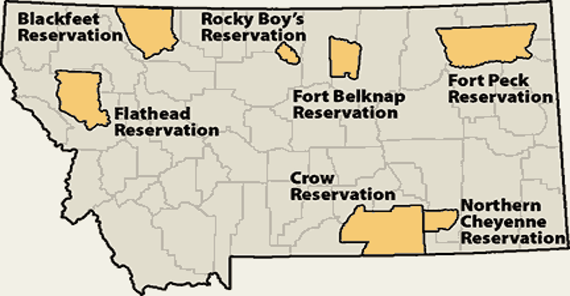
Valerie Falls Down joined MLSA in 2021 to launch and run TAIP. She was already certified as a Tribal lay advocate on the Crow Reservation; since joining MLSA, she has also become certified in the Chippewa-Creek Rocky Boy’s and Northern Cheyenne courts and aims to become certified to practice in all seven jurisdictions. As coordinator, Falls Down was instrumental in securing partnerships with Tribal courts as well as the University of Montana’s Alexander Blewett III School of Law and the Montana State Bar Indian law section. She also recruited an advisory board of judges, law professors, attorneys, and community members. The board was essential in establishing a curriculum for students, with the group settling on topics like ethics, family law, Tribal court forms, and trauma-informed advocacy, among others.
Today, the course is in its fourth iteration. Over 14 weeks, potential advocates learn how to be a civil advocate—they learn the knowledge associated with taking Tribal bar exams as well as how the Tribal courts work. They participate in mock trials and shadow MLSA Tribal attorneys; they also receive funding to take the Tribal bar exam, free business instruction on how to set up their practice, and $1,000 to set up their office.
To date, MLSA has trained just over 60 students (roughly 20 a year), each of whom the organization continues to support with mentorship. Tribal lay advocates who graduate from the program receive referrals from MLSA as well as from the large network of alumni and teachers. While advocates set their own fees, “participating advocates must agree to charge clients referred by MLSA no more than a modest means rate,” according to MLSA. Falls Down, who was previously a member of the Montana Missing Indigenous Task Force, also asks TAIP graduates to take such cases pro bono if they are able to.
Erica Shelby was in the first TAIP cohort, 2021–2022. She had been practicing for about seven years when someone forwarded her information about the program.
I think all courts are flawed, but I think that they’re also healing
Erica Shelby, Tribal lay advocate
“We try to get individuals who have legal experience, because of the legal terminology that our instructors trust that everybody knows from the get-go,” Falls Down says. “Someone who does not have any legal experience might feel overwhelmed and might get lost, which has happened.”
Shelby is now licensed in the Blackfeet Tribal Court, where she takes referrals mostly around family law. (Family law was the most requested need when Falls Down and Paul surveyed Tribal communities.) But using her legal training and funding from her Tribal lay advocate practice, she’s also begun Just Indigenous Corporate Services, an organization providing advocacy and investigative services for missing and murdered Indigenous individuals across Montana’s tribal lands. (As an advocate, Shelby is certified to work only in civil law matters, so while Just Indigenous Corporate Services touches criminal law, it is not under her Tribal lay advocate banner she operates). Most recently, Shelby helped a family investigate a hit-and-run that killed Mika Westwolf, a young member of Blackfeet Nation, and supported them as they pursued accountability and legal action against the driver.
Both sides of Shelby’s work are rewarding, even in less-than-ideal conditions, because she helps people move on. “I think all courts are flawed, but I think that they’re also healing,” Shelby says. She doesn’t take every case—just the ones where she connects with the clients and the subject at hand. “When we’re able to get results, we’re helping change the reservation, heal the reservation, one case at a time.”
Centering cultural competency
After almost a decade away from home working in the air force and in law enforcement, Brenna Hanley returned home to Navajo Nation in Arizona. (Hanley’s clans are Kinyaa’aanii [Towering House], Tó’ahéédlinii [Water Flows Together], Ashííh [Salt People], and Tachiinii [Red Running into the Water People].) She was working on her master’s in psychology focused on criminology and justice when someone forwarded her a flyer for the National Tribal Trial College (NTTC).
Operating out of the University of Wisconsin and in collaboration with the U.S. Department of Justice and Office of Violence Against Women, the NTTC is now in its 12th year. It is a free six-month skill-building course for would-be Tribal advocates held online with a one-week in-person intensive in Madison, Wisconsin. After completing the program and passing the Navajo Nation bar exam, Hanley worked as a prosecutor for six years. Today, she is a full-time law student at the University of New Mexico, chief operating officer and teaching faculty at the NTTC, and mother of three kids. (Valerie Falls Down, who helped establish the Montana program, is also a 2021 NTTC graduate.)
I was born and raised on Navajo, and so even learning about other Tribes was kind of foreign to me.
Brenna Hanley, COO, National Tribal Trial College
To date, more than 340 Tribal advocates representing 108 Tribes from 26 states have completed the intensive litigation certificate. For Hanley, NTTC was the foundation of the career she is building today.
As a student, there was culture shock. “I was born and raised on Navajo, and so even learning about other Tribes was kind of foreign to me,” she says. During the first 20 weeks, students view video lectures and complete homework assignments according to their own codes. The curriculum is built to encompass the unique differences between reservations. Before they are accepted, Hanley says, students must submit a letter from a local Tribal judge stating that they will be allowed to practice. Throughout, the curriculum encourages “cultural competence” and local understanding, as individuals enroll from around the country.
“NTTC focuses on the cultural side: how to be patient and how to respect your elders and how to speak in a courtroom. It’s totally different from a Western court system,” she says. NTTC prioritizes people already living and working in their own communities. You cannot have a J.D. to gain admission.
In addition to helping alleviate the scarcity of legal representation on reservations, the program also helps students exploring their own Tribal codes identify gaps they want to rectify, Hanley says. “Some of them may not have certain criminal statutes; some of them may not have the civil children’s code,” Hanley says. “At the beginning of the program, we help students get their codes, and then we start helping them understand them. Then they start seeing, Oh, we’re missing this. Why don’t we have this? We encourage them to advocate for that. You do it. You propose change and implement whatever it is that you need.”
Increasing access to justice
As policymakers and scholars grapple with how to “solve” the legal desert problem, a common question is: Are lawyers part—let alone the most important part—of the solution? Lawyers in the United States have typically been cautious about expanding the range of individuals allowed to provide legal advice—we’ve covered this in issues focused on “Alternative Legal Service Providers,” “Perspectives on Legal Regulation,” and “Emerging Models of Legal Professionals.” But what if the alternative is not an alternative at all, but something entirely different?
In her paper, van Schilfgaarde writes: “Lay advocates offer unique access to justice opportunities, including filling a gap between prohibitively expensive attorneys and pro se representation. But we should resist framing lay advocates as simply attorney replacements.”
In addition to limited legal licensed technicians, a growing movement is calling for community justice workers, trusted community members who help individuals navigate complicated legal bureaucracy. Alaska’s community justice worker program, for instance, helps low-income individuals access food stamps and unemployment benefits; they work within existing institutions and partnerships, like the Alaska Native Tribal Health Consortium.
[Tribal lay advocate licensure is] a sovereign community having its own rules around what it means to practice law.
Alison Paul, executive director, Montana Legal Services Association
Paul, however, distinguishes between community justice workers and Tribal lay advocates: “[Tribal lay advocates] are actually people who take a bar exam and are licensed in their own communities and Tribal courts,” she says. “And I like to highlight the difference, because it’s a sovereign community having its own rules around what it means to practice law.”
Hanley is also quick to note Tribal systems are unique. As she enters her second year of law school, she thinks of her time as a prosecutor on Navajo Nation as something distinct. “I’m still learning the Western system. There’s a Tribal pathway and a Western pathway—and they might be grounded in some similarities, but they are two very different paths,” she says. “I feel like I understand those two languages, but there’s no combining them.”