
We began, twenty years ago, with a conviction and a problem. The conviction was that reflection on the moral assumptions and foundations of practical affairs is both intellectually worthwhile and socially valuable. Philosophy in this broad sense, we thought, could contribute to identifying and understanding the ethical issues in public life, including those in the professions. The problem was that few philosophers knew enough about professional life, and few professionals enough about philosophy, to teach and write effectively on ethical issues in professional and public life more generally. Teachers and scholars of professional ethics were often isolated from colleagues in other faculties who share their interests. In the curriculum, systematic discussion of ethics was mostly confined to specific courses in the philosophy department or to designated courses in the professional schools. The Center has made significant strides in breaking down these barriers.
Dennis Thompson, Ethics at Harvard 1987-2007
In 1986, Harvard President Derek Bok was finally able to persuade Dennis F. Thompson, then a professor at Princeton University, to come to Harvard to help Bok fulfill his decade long quest to answer a question Bok provocatively posed in his seminal 1976 essay: Can ethics be taught? The answer, Bok was convinced, was definitely yes – but only through a “problem-oriented” curriculum that would give students the theoretical and practical tools that they would need to prepare them for the moral dilemmas and ethical decisions that they would face throughout their careers.
By the time Bok published this clarion call, Dennis Thompson was already laying the theoretical groundwork for just such an intellectually rigorous and practically informed approach to scholarship and teaching about ethics. Beginning with his pathbreaking 1970 book The Democratic Citizen: Social Science and Democratic Theory in the 20th Century, Thompson was one of the first political theorists to connect contemporary social science to theories of democracy. Over the next several decades, Thompson and his long-time collaborator Professor Amy Gutmann, (who would go on to be the 8th President of the University of Pennsylvania and U.S. Ambassador to Germany) would mine this connection to build a theory of “deliberative democracy” that would become one of the most influential and widely debated approaches to understanding the strengths and weaknesses of our democratic ideals and institutions. And from the start, Thompson and Gutmann demonstrated that the relationship between ethics and politics could be taught through a series of real-world case studies that the two scholars compiled in a 1984 volume titled Ethics and Politics: Cases and Comments, the first casebook of its kind. (Through its many subsequent editions, the book is still widely considered the most important in the field.) It is therefore not surprising that Bok was so determined to bring Thompson to Harvard.
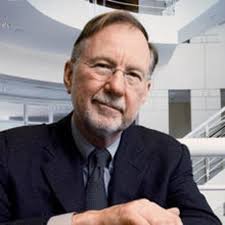
As Thompson’s quote above makes clear, his ambition for Harvard’s new ethics initiative was as straightforward as it was audacious: to bring insights from moral and political philosophy to the teaching of professional ethics and to test the theories of philosophers in the reality of professional practice. And to do this on a university-wide level in a university famous for its credo that “every tub” (meaning every school and department) floats “on its own bottom” free from central supervision or control.
To accomplish this herculean feat, Thompson first enlisted an all-star cast of senior scholars from philosophy and the professional schools to create an interdisciplinary dialogue about the relevance of philosophical principles to professional ethics. Among the giants he persuaded to join his cause were John Rawls, Amartya Sen, Judith Shklar, Martha Minow, Michael Sandel, and T.M. Scanlon (whose “Speaker’s Corner” interview appears at the end of this issue). But as important as these senior scholars were, at the core of Thompson’s vision was the creation of a new generation of scholars and teachers who would embrace the intersection between “Ethics and the Professions,” as the Safra Center was initially called. Thus, in his second year Thompson launched a fellowship program to bring junior faculty teaching ethics in professional schools (at Harvard or elsewhere) together with young philosophers and political theorists for a year-long exploration of the intersection between philosophy and professional ethics. Fellows were relieved of all teaching responsibilities and given the opportunity to interact with a who’s who of leading philosophers and theorists from across Harvard and around the world, and to develop their own ideas in a weekly seminar guided by Thompson.
For the next 23 years until his retirement in 2009, Thompson built the Safra Center into Harvard’s first truly interdisciplinary university-wide initiative and the world’s preeminent academic center for the study of ethics. Along the way, he also founded the Association for Practical and Professional Ethics, which now has over 2000 members across hundreds of schools around the world. And he continued to publish pathbreaking scholarship on ethics and democratic theory, including his many books with Gutmann, most recently The Spirit of Compromise: Why Governing Demands It and Campaigning Undermines It, as well as works that continue to define the intersection between moral theory and professional ethics, including Restoring Responsibility: Ethics in Government, Business, and Healthcare, Just Elections: Creating a Fair Electoral Process in the United States, Ethics in Congress: From Individual to Institutional Corruption, and Political Ethics and Public Office, along with dozens of articles in books, leading scholarly journals, and the popular press. Thompson was also consulted frequently by leaders seeking his insight and judgment, including the Joint Ethics Committee of the South African Parliament, the American Medical Association, the U. S. Office of Personnel Management, the Department of Health and Human Services, the White House Office of General Counsel, and the Senate Ethics Committee in the investigation of the so-called “Keating Five.” And he was one of the most respected and influential voices within the academy, serving as Harvard’s first Deputy Provost and advising universities around the world, including ten years as a member of the Board of Trustees of Smith College, the last five as vice-chair.
But of all of Dennis Thompson’s important accomplishments, his proudest was the hundreds of junior scholars who passed through the fellowship programs that were at the core of his vision for the Safra Center. Thompson knew that if young academics were given the opportunity to explore the intersection of philosophy and the professions it would change the trajectory of their teaching and scholarship for the rest of their careers — and through their teaching and scholarship, the outlook and understanding of the countless students and colleagues who these fellows would go on to influence.
I know how important this was to Dennis because I had the good fortune to be one of the lucky junior scholars who experienced his vision first-hand. In 1989, Dennis selected me to be a part of the program’s third class of fellows. I was not an obvious choice. It was only my third year of teaching at Harvard Law School. I had no prior academic experience, nor any training in philosophy. But Dennis took a chance on me, and like the hundreds of other fellows who were granted this rare privilege in succeeding years, this experience profoundly changed my life.
It is no exaggeration to say that virtually everything that I have done in my academic career has been directly influenced by what I learned as a fellow – and by the nearly four decades of friendship with, and mentorship from, Dennis and the incredible collection of senior and junior scholars that I met during that pivotal year. My first articles on the intersection between legal and political theory and legal ethics and the regulation of lawyers were drafted during my fellowship year. Everything that I have written subsequently on the moral and ethical implications of racial identity on professional roles, the duties of lawyers as professionals and as citizens, and the complex interplay between institutional structures and individual strategies in the making of lawyers’ careers has been inspired by Dennis’s vision that philosophy can play an important role in illuminating professional norms and practices. And from teaching a seminar with Dr. Linda Emanuel on Ethical Issues in Clinical Practice: Physicians and Lawyers in Dialogue that we began planning during our year as Safra fellows, to co-authoring a “problems-oriented” casebook with my colleague Andrew Kaufman, one of the first senior faculty Dennis recruited to his new ethics initiative, to challenging law schools to live up their ethical obligation to study and teach about the profession, the lessons that I learned as a Safra fellow continue to shape my teaching as well.
But Dennis’s most profound influence on my career has been in shaping my vision for the Center on the Legal Profession (CLP). For over 30 years I have tried to make the CLP into the same kind of vibrant intellectual community that fosters the development of junior scholars at Harvard and around the world and brings together the worlds of theory and practice that Dennis so brilliantly fostered during his years as the faculty director of the Safra Center.
Sadly, we lost Dennis on March 30, 2025. His passing leaves a void in our field — and a hole in my heart — that will never truly be filled. It is therefore with profound humility and the deepest gratitude that we dedicate this issue of The Practice on Moral Agency to Dennis’s life and work.
Each of the articles in this issue is a direct reflection of the continuing influence of Dennis’s original vision for the Safra Center. W. Bradley Wendel’s lead article on accountability, conscience, and dissent, and the book Canceling Lawyers: Case Studies on Accountability, Toleration, and Regret from which it is excerpted, is exactly the kind of scholarship that Dennis sought to promote, by scholars like Wendel with rigorous training in both philosophy and law. The two supporting stories on fighting “corporate capture” of law firms and navigating ethics as a government lawyer seek to build on Dennis’s insight that the study of professional ethics must be attentive to the institutional incentives and constraints that mediate — but should never fully define — how professionals understand their ethical and moral obligations. And my conversation with Tim Scanlon, one of the philosophers Dennis recruited to start the Center and who has been a friend and mentor to me ever since, is just the kind of engaged and mutually respectful discussion that Dennis dreamed of creating.
As I tell Tim at the close of our conversation, I know that Dennis is somewhere smiling seeing two of the original members of the community he worked so hard to create continuing to explore the connection between philosophy and professional ethics. But I also know that this would not stop him from worrying about whether he had done enough to create the right environment for this critical conversation to take place. Until his retirement as Safra’s faculty director, whenever I would see Dennis in November (usually over dinner with great food and even better wine – a passion we both shared), he would invariably say that he was worried about whether “the seminar was coming together” to produce the kind of interdisciplinary conversations he hoped to spark. And, just as predictably, when I would see him again the following May, he would happily report that he thought that the engagement between the current group of fellows and senior scholars might be “the best ever.”
At his core, Dennis was a perfectionist who never underestimated the difficulty of creating — and sustaining — a conversation about ethics capable of spanning disciplinary boundaries and the even wider chasm between theory and practice. And yet he always remained optimistic that with hard work and humility, the Safra Center might foster just this kind of unprecedented collaboration. It is a mark of the efficacy of Dennis’s combination of angst and resolve that Bok, also a notorious perfectionist with grand ambitions for the university, declared when Dennis stepped down as faculty director that Dennis’s success had exceeded even Bok’s “optimistic expectations.” As we take this opportunity to celebrate Dennis Thompson’s life’s work, it is abundantly clear that his influence on the field of ethics — and even more on the people he mentored and inspired — will continue to exceed even Dennis’s own cautious but always optimistic expectations for generations to come.
David B. Wilkins is the faculty director of the Harvard Law School Center on the Legal Profession.