
David B. Wilkins, faculty director of the Center on the Legal Profession, sat down with Richard Susskind, the profession’s leading scholar on AI and law, to talk about the future of the profession.
David B. Wilkins: As we celebrate the 30th anniversary of your pioneering book, The Future of Law, and you rerelease it with additional reflection and commentary, what surprised you about what you thought might have happened then, and what actually did happen?
Richard Susskind: Thank you for inviting me to reappear in The Practice. In 1996, I wrote The Future of Law to claim that information technology, as we then called it, would have a profound effect on the way that law was practiced and justice was administered. In retrospect, this sounds prosaic. One thing that has surprised me and I failed to understand at the time—and I say this not in a disparaging way—was just how slow the general counsel community would be to adapt. Today’s general counsel still say the same three things to me. First, they’re under pressure to spend less on external law firms. Second, they’re under pressure to reduce their internal head count. And third, they have more legal and compliance work to do than ever before. At the same time—and again, I say this with no rancor—major law firms around the world are reporting ever greater profits. There’s a very strange imbalance there, and it has indeed surprised me that the in-house community hasn’t pushed a very profitable and successful law firm community to deliver service differently, to reduce costs, to rethink the way in which legal services might be delivered. I think the advent of generative AI and everything that’s happened since is perhaps shifting that trend.
We are essentially going to see a paradigm shift in the delivery of legal services and in the administration of justice.
Richard Susskind, CBE, KC, president, Society for Computers and Law
One of my main themes in ’96 was—and this now sounds laughable—that AI rather than email would come to be used as a dominant way of communicating between lawyers and clients. The Law Society in England and Wales said I shouldn’t be allowed to speak in public for suggesting this. I was also suggesting that lawyers might use online legal research rather than traditional law reports, and I was said to be offending the dignity of the law library. Our views change, but having now traveled the road that then lay ahead, we have the benefit of hindsight.
Wilkins: I very much remember when they threatened to draw and quarter you. But the kind of fundamental structure of the legal profession has actually remained remarkably stable. The structure of law firms, the pyramid model, the relationship between in-house counsel and law firms, all still remain. As you know, some people say, “You know what? This new technology is just going to be absorbed the same way that the others were and the basic fundamental structure will remain the same.” I know that you doubt that is true, but what’s different about this?
Susskind: This takes me back to a distinction I drew in ’96 between the two broad ways in which technology can be deployed in law: automation and innovation. In the former, we can essentially streamline the way we’ve always worked. We graft digital technology onto existing practices, and the system becomes more efficient and more productive. I call this automation, and your late great colleague Clayton Christensen called this “sustaining” technology. What we’ve seen for the last 70 years or so is that the impact of digital technology on law has largely been sustaining. It’s largely been to preserve, to strengthen, to deepen the way that lawyers have always worked.
If I look at other industries and sectors, and even indeed other professions, however, I see something different emerging with what I call “innovation.” I had predicted this would emerge quicker than it has done in law, but I think I can see this coming soon because of the catalyst of AI. By innovation, I mean the use of digital technology to allow us to do things that previously weren’t possible. The most exciting part of this is how it could be used to help solve the global access-to-justice crisis. Historically most people have been unable to understand, to assert, and to enforce their legal rights. We’re seeing the glimmer here in AI of a set of systems and capabilities which might empower individuals who otherwise have no realistic access to law and lawyers—to help them understand what their legal position is, to be able to stake out their claim, and to be able to use processes that they can now understand. That for me would be a major move ahead, but it’s not automating something we already have.
The professions don’t exist in nature like water or rivers or trees. They’re an effective way of responsibly sharing knowledge and expertise in a print-based industrial society.
Richard Susskind
But my prediction back in ’96—and it’s one I really stand by—is that we are essentially going to see a paradigm shift in the delivery of legal services and in the administration of justice. A paradigm in this context refers to a worldview, or a way that we regard a particular discipline or a particular set of problems—for example, the shift away from thinking that the earth was at the center of the universe was a shift in paradigm. What I was saying in my original work—and if there is an argument of which I’m proud, it is this—that I think digital technology will precipitate an analogously major shift, not simply an automation, an innovation in the way in which citizens regard the law.
This relates to the book I wrote with my son Daniel Susskind, The Future of the Professions, where we asked the question, “Why do we have the professions at all?” On one level, one can see that the modern professions emerged after the Industrial Revolution as a way of solving a particular type of problem, and the problem is that we as humans don’t know enough. When we don’t know enough in situations which are of considerable significance to our health, our wealth, and so forth, we seek out experts, and we’ve built an organizational and institutional structure around these experts. Daniel and I call it “the grand bargain.” We give exclusive rights to these professional people, and in return, we expect accurate, accessible, honest work from them. The way we produce and share practical expertise in society, until now, has been through human professionals. But it’s a construct. The professions don’t exist in nature like water or rivers or trees. They’re an effective way of responsibly sharing knowledge and expertise in a print-based industrial society.
But we’re now moving into an AI-based digital society. When we moved from a pre-print to a post-print society, we saw fundamental shifts in how much law could be made, how it was generated, how often it could be changed, who was authoritative to resolve disputes, who was reliable to offer guidance. Just as we found new ways of distributing information in society, then I am expecting a similar kind of shift in our economic, financial, legal, and political institutions as we move into an AI-based society. I’m of the view that what we’re seeing now with AI is akin to the invention of the printing press or the steam engine, except the uptake is going to happen in a small number of years rather than over many decades. The idea that our major institutions will remain unchanged is mistaken—we cannot cope with 21st-century digital problems with 19th-century analogue institutions.
We will cope differently. The professions will no longer be the main way that expertise is distributed in society. Congregating in a single point in space and time will no longer be the way that we handle disputes in society. My interest in all of this is to increase access to justice, to make sure that people who would otherwise be underserved can now be empowered. But my basic thrust is that where most people in the current debate see AI and law as AI for lawyers, in contrast, in the long run, I see AI and law meaning AI empowering non-lawyers.
The Future of Law: Reflections and Predictions (OUP 2026)
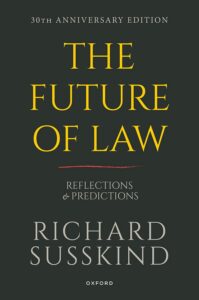 The Future of Law: Reflections and Predictions marks the 30th anniversary of Richard Susskind’s seminal work on the transformation of legal and court services. First published in 1996, the original edition argued that technology would fundamentally reshape legal practice and the administration of justice, an idea that many lawyers at the time dismissed. Three decades on, with artificial intelligence now advancing at a remarkable speed, many of those predictions have become reality.
This anniversary edition reproduces the original text in full and unaltered form, offering readers a rare opportunity to revisit the foundations of modern thinking about law and legal technology. Alongside the classic chapters, Susskind provides new commentary for each, reflecting on what was argued 30 years ago, assessing how these ideas have endured, and considering their implications for the years ahead.
In addition to looking back, the book offers an entirely new restatement of Susskind’s current views on the future of law, with particular focus on the likely impact of AI on legal work, legal institutions, and access to justice. It situates contemporary developments in a broader historical context, helping readers understand how the legal world has advanced, and how profoundly it may yet change.
Clear, authoritative, and forward-looking, The Future of Law: Reflections and Predictions is essential reading for practitioners, judges, policymakers, technologists, academics, and anyone interested in the evolving relationship between law and digital technology.
Wilkins: I want to pick up on that because one of the debates that’s emerging is between the optimistic view around access to justice, which you have framed brilliantly, and the other is that it’s simply going to reinforce the ability of the powerful to get their way in the world. As Marc Galanter famously argued 60 years ago, the haves will always come out ahead because they have all the resources to advance the best technology. How do you think about AI intervening in that very long-running dispute?
Susskind: The unequal playing field has always been to the discredit of the justice system. We now have the opportunity to design the next generation of dispute systems in light of the errors we’ve made in the past. Indeed, though, one of my biggest worries is that we’re seeing an unprecedented concentration of capital and power in a very small number of non-state-based organizations. As we think about the design of new systems, we don’t need to automate our current court systems. I believe AI systems for dispute resolution should be state-backed rather than private-sector-backed, but we need to build in the values that are important to us. If it’s left to the private sector, then imbalances will remain, which is what’s happened with arbitration and mediation.
Let’s try to bring the best and suppress the worst of AI.
Richard Susskind
It’s often said to me—and it’s a related point—that people cannot imagine how the courts will cope given now that, for example, in a simple insurance claim, every individual has access to ChatGPT. My answer to that is, of course, that the courts wouldn’t cope because these are 19th-century institutions that weren’t designed for a world in which everyone was empowered to be their own lawyer. We need to have dispute mechanisms which match the capabilities of the users, and I have little doubt in the future they’ll be AI-based.
The challenge I put out with this technology is that we have to think not just about developing a new generation of state-based dispute resolution systems but that we have to find ways of dispute avoidance. That means putting the fence at the top of the cliff rather than the ambulance at the bottom. What mechanisms might we have in place that will discourage disputes from emerging at all? If there’s far greater knowledge of the law, then maybe the unscrupulous landlord will think twice before raising an action, because the otherwise unempowered tenant will have tools available at their fingertips. One can see a world where “better informed” means fewer people taking advantage of a power imbalance.
My plea is that we think not just about designing better dispute systems, but we think, What’s the equivalent in law of noninvasive therapy in medicine as opposed to robotic surgery? How can we use AI tools to help people who have existing or potential legal problems essentially resolve them very differently, but in ways that are less painful, less intrusive, quicker, cheaper, more convenient? More than that, how can we bring in the spirit in the law of the idea of preventive medicine–preventive legal work. We’re already seeing the emergence of an interest in legal risk management where major organizations, rather than waiting for big problems to arise, will, for example, have agents roaming around their financial and other systems, identifying early markers of legal problems and difficulties.
I do fear a lot of our debate about AI generally, and legal AI in particular, is rather polarized. It seems to me that AI is not like a football team that you need to support or reject. It’s rational to be both excited and wary. It’s rational to be both optimistic and pessimistic. What I would want for lawyers is to be able to weigh arguments from both sides. Let’s try to bring the best and suppress the worst of AI. We have this once-in-a-century opportunity to rethink and redesign much of what we do in law.
Wilkins: That’s a wonderful way of saying what lawyers should bring to bear on this debate. But of course, the place at which lawyers are least likely to be balanced is when their own identity and future is at stake. A lot of what you describe is exactly the unraveling of the 19th-century bargain that put professionals like lawyers at the center of extreme power and authority. What is the argument for lawyers about why this shift, which actually decenters them, isn’t going to result in the title of your other brilliant book, The End of Lawyers? How do you think about all of this with respect to the professional identity of lawyers?
Susskind: Lawyers must confront a set of ethical issues and a set of market issues. The ethical challenge is to identify what is intrinsically important about the way that law is currently practiced and that justice is administered. Even if AI systems can match human performance, we should preserve the traditional way in and of itself as a moral imperative if our current practice is intrinsically valuable. That argument perhaps holds most water in relation to the jury system. One could imagine an AI system that might outperform a group of laypeople in determining the facts, but we might nonetheless prefer humans’ continued participation in the process because of some broader ideal—that a jury of peers is intrinsically valuable. I accept that.
We should always be open to thinking of ways in which we might meet community needs better.
Richard Susskind
But there’s a big part of me that has felt for quite a while that the law is no more there to provide a living for lawyers than ill health is there to provide a living for doctors. It’s not the purpose of law to keep lawyers engaged. Lawyers should thrive and survive in my estimation because they bring value that no one else does, and not because, for example, we regulate others out of the field or because we put up obstacles to fundamental change.
But the market forces in some ways are going to be more interesting. The competition that will likely kill current lawyers won’t look like current law firms. We’re now seeing credible competitors from startups through to various big AI companies. I’m speaking regularly to chairs and managing partners of the world’s largest firms who scarcely gave me the time of day five years ago and are now recognizing that something disruptive is coming. Historically, it’s been hard to convince a room full of millionaires that they’ve got their business model wrong, but they’re less confident now.
I don’t abandon many of the ideals and the benefits that great lawyering brings. There’s no disloyalty on my part to great professionals and great judges. I think we should simply always be open to thinking of ways in which we might meet community needs better. In many ways, AI is providing a catalyst that we’ve long needed to take a look at what we do to keep the best of our traditional work and optimize that, but be willing to transform and introduce ways of increasing our reach and correcting some of the inefficiencies in the market.
One example here is that it is quite remarkable in most jurisdictions that people are assumed to know the law, and yet there’s no formal method for what Jeremy Bentham many years ago called “promulgation”—a formal means by which people are notified of new law or changes in old law. One can now see that legislating need not simply be a publishing and printing exercise. We could have systems which would enable people to understand how emerging law affects them. That’s an expectation we might have in the next decade: that a modern democratic legal system is one that doesn’t simply publish law but strives to use the enabling technologies to ensure that people are aware of new developments.
Wilkins: I would say the one place in which those discussions of change are least likely to happen and perhaps least productive are in legal education. In fact, the major discussion around AI tools is around cheating and banning them. How should law schools be thinking about professional and ethical formation and skill development in a world which is still in transition from the 19th-century way of doing things to what will be the mid-21st-century way of doing things?
Susskind: Right now, we’re in transition, but we don’t actually know what we’re in transition to. I know there are many AI experts around the world who speak with confidence about the future. But in another work, How to Think About AI: A Guide for the Perplexed, I point to six different hypotheses about the future of AI, and this shows that even among AI experts, there’s deep disagreement about where this technology is going, where it’s taking us, where we’re taking it.
The answer is we don’t know how AI will unfold, but to default simply to the old ways of working because we don’t know doesn’t work as a strategy.
Richard Susskind
This raises the next question, which is what are we training young lawyers to become? If you believe the benefits of AI lie mainly in automation, then the fundamentals of legal practice and justice administration will remain as they are. We’re then preparing young lawyers to become practicing lawyers and judges and academics in a world where we have a remarkably powerful set of tools, but they will be working in the same paradigm.
If on the other hand you believe these systems will become as capable as us and, in fact, maybe more capable than us, then it’s not at all obvious that we will need the same kinds of lawyers, or nearly as many lawyers, or that they will be engaging in the same types of activities in which they’re engaged today.
The answer is we don’t know how AI will unfold, but to default simply to the old ways of working because we don’t know doesn’t work as a strategy.
Another answer here comes from my son Daniel’s new book, What Should My Children Do? where he’s asking more generally about education. He’s very strongly of the view that he calls “teach both, test both,” and this can apply in law. He goes back to the time when there was heavy debate about electronic calculators and whether or not we should still learn mathematics. There was an English academic who believed that we have to understand the operations of mathematics manually but should also be able to use the tools available to us, and so, we should teach both and we should test both. It seems to me that this applies equally in law. Who knows what’s going to happen over the next five, 10, 20 years? It may well be there’ll be a more rapid shift in AI than any of us is expecting, but we can only play the hand we are dealt.
We should teach both and test both. I would be wanting much of the law curriculum—in terms of legal principles, legal doctrine, legal research, legal ethics, critical thinking, jurisprudence—to be taught as always it was. But I would also, in parallel, want to train a generation of young lawyers to be able to use existing and emerging systems effectively and confidently alongside the basic knowledge and understanding they’ve acquired.
Wilkins: Well, Richard, I am quite confident that people now realize if they’d actually listened to you 30 years ago, although they might not have predicted everything, they would’ve had a much better understanding of the world as it developed and be more prepared to meet it. And I have no doubt that if people listen today, that 30 years from now others will be able to look back and have that same feeling. Thank you so much for sharing the time with our readers.
Professor Richard Susskind, CBE, KC, is president of the Society for Computers and Law and one of the most-cited authors on the future of legal services. The 30th-anniversary edition of his book, The Future of Law: Reflections and Predictions, was published by Oxford University Press in September 2026.
David B. Wilkins is the Lester Kissel Professor of Law and faculty director of the Harvard Law School Center on the Legal Profession.
Image Credit: Shutterstock // smolaw