
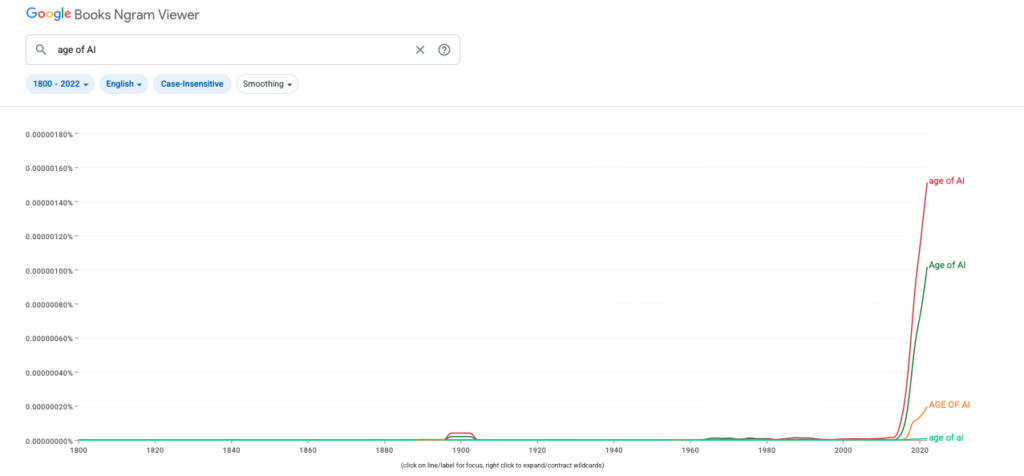
When you pull up the Google Books Ngram Viewer, which allows you to search for how often sequences of words appear in digitized books over time, and plug in “age of AI” or “era of AI,” you see the same sort of graph: a relatively flat line for 200 years, then a sharp jolt up in the 2010s. What precipitated such an incline? It wasn’t just tech journalists grappling with what AI would do to our timeline but a more widespread reckoning. Indeed, in 2021 the unlikely trio of Henry Kissinger (former secretary of state), Eric Schmidt (former CEO of Google), and Daniel Huttenlocher (first dean of Cornell Tech) published the book The Age of AI. In 2019 Robert Downey Jr.—because of Iron Man, no doubt—hosted a YouTube Learning series called The Age of AI. Both the book and the series attempted to grapple with what the future might bring when AI had infiltrated our ways of working and knowing.
But what does it mean to be in the “age of” AI?—or the “age of” or “era of” [insert your noun of choice].
In this story, we decenter “AI” and refocus on the idea of “ages” or “eras,” asking how those with historical training make sense of periodization and its driving forces. We spoke to historians Jo Guldi, professor in the department of data and decision sciences at Emory University; Eric Schatzberg, professor in the school of history and sociology at Georgia Tech; and Lee Vinsel, assistant professor of science, technology, and society at Virginia Tech, asking them about the role of periodization in our attempts to understand the world and how to make sense of the era of AI while we are living in it.
Era debates
Why do historians periodize? What is it good for? “I think you’ll get as many answers as you ask historians,” Vinsel says. Periodization is an integral part of the field, he says, and it’s something historians love to debate: where to draw the lines around certain segments of time. “Some of my colleagues really think that a core thing that we do is identify shifts, and if you’re doing shifts, then you’re going to at least have two periods—a before and an after.” But it’s naturally a heuristic, says Schatzberg.
As public historian Alexis Coe recently wrote in her newsletter, “Periodization can create false walls. History does not change the set when one era ends and another begins—and the old cast often lingers.” In fact, the act of defining periods—of ages and eras—is not a neutral but a political practice, indicating what we value and what we center.
Some of my colleagues really think that a core thing that we [historians] do is identify shifts, and if you’re doing shifts, then you’re going to at least have two periods—a before and an after.”
Lee Vinsel, assistant professor of science, technology, and society,Virginia Tech
The Industrial Revolution is a case in point: Did the technological shifts cause the economic shifts or vice versa? In the 1980s and ’90s, economic historians frequently debated the Industrial Revolution’s standing as one of the key periods in human history. If the first industrial revolution lasted roughly 70 years, for instance, how could such a long stretch of time constitute a revolution? Others point to the rise of GDP, productivity statistics, and pivotal advances in steam power, textiles, and iron and conclude that the period—albeit gradual—was indeed remarkable.
Joel Mokyr, the Robert H. Strotz Professor at Northwestern, would go on to share the 2025 Nobel Prize for explaining how innovation drives long-run economic growth, looking pointedly at Britain during the 18th–19th century. Charting this transformation in his introduction to The British Industrial Revolution: An Economic Perspective, he argued that the debate about whether or not the revolution was a “useful concept” is really about “discourse”: “Does the term communicate?” he asked. “Do most people with whom we want to converse (colleagues, students, book purchasers) know by approximation what we mean when we use the term? And can we suggest a better term to replace it in our conversations?”
The technology habit
For many academics, technology is the pivotal anchor used to demarcate periods—for instance, before and after the printing press; before and after flight; before and after the nuclear age; before and after the Internet. (You could even go further back to the Bronze Age or the Iron Age.) There are good reasons for technology’s pull when it comes to periodization: inventions come with dates, and a single machine can seem to explain cascades of change downstream, as well as income differences between countries, as C. B. Frey argues.
The way we periodized history often carries with it prejudices.
Jo Guldi, professor, Emory University
But technology is not the only axis, and there are good reasons to resist it as an era-defining rubric. Historians have long carved time along other lines: ideas (the Age of Enlightenment), geopolitics (the Cold War era), and economic integration (the age of globalization—and de-globalization). Eric Hobsbawm’s famous trilogy—The Age of Revolution, The Age of Capital, and The Age of Empire—periodized the 19th century by politics and power, not machines. Periods can help you understand the pervasiveness of different values and social systems, Guldi says.
In recent decades, scholars have likewise challenged the categories historians use to divide up time. Guldi points, for instance, to Helge Jordheim and Dipesh Chakrabarty, both of whom have questioned conventional forms of periodization. “They’ve said it’s too simplifying,” Guldi says, explaining that “the way we periodized history often carries with it prejudices.” Chakrabarty, in particular, has shown how geographical differences were historically converted into temporal ones: Europe was imagined as the site of modernity and progress, while colonized societies were treated as if they occupied an earlier stage of the same historical trajectory. Historians therefore need to ask how categories of time also organize space—and what assumptions accompany them—an issue that returns whenever a new historical age is named from one particular corner of the map.
The industrial revolutions, though, are the tech habit at its most institutionalized. Historians largely date the first industrial revolution to roughly 1760 to 1830, marked by technological transformation around steam, textiles, and iron, which in turn had profound economic, political, and social effects. The second industrial revolution, roughly 1870s until World War I, concentrated on steel, electricity, and railroads (the machine age), while the third was driven by computerization (the information age). Many in the tech industry have cited AI, and its relationship to advances in quantum computing and robotics, as powering the “fourth industrial revolution.”
Others, like Carlota Perez, disagree, arguing that AI is a continuation of the Information and Communication Technology (ICT) revolution that began in the 1960s. “A revolutionary technology is not the same thing as a technological revolution,” says Perez, who is honorary professor at the UCL Institute for Innovation and Public Purpose and a leading scholar on innovation and historical change. Why does it matter? Industrial revolutions involve larger forces of societal and policy change, she has said. It may still be too early to say if what we’re seeing today is “enough” to drive such global change.
Invention is not diffusion
The invention of a technology is different from its diffusion, many historians argue. Vinsel, who coauthored The Innovation Delusion with Andrew Russell, says that ages are often “about new stuff coming into the world.” But what that means is that “it kind of misses how much of the stuff around us is fundamentally old and has been relatively stable.” When he hears people say, “Technology’s changing faster than ever,” he hears an oversimplification. “When they say that, they just mean digital technology,” he says. “Your toilet’s not changing faster than ever. Your car’s not changing faster than ever, and actually computers aren’t either for the most part.”
The story of how technology spreads can be psychological.
In The Shock of the Old: Technology and Global History Since 1900, David Edgerton distinguishes between invention, “the creation of a new idea”; innovation, “the first use of a new idea”; and diffusion, “the spread of that idea.” When we look back in history, invention takes center stage, but a history centered on diffusion shows how society, labor, and the economy actually changes.
An oft-cited 1990 paper from Paul A. David, “The Dynamo and the Computer,” makes this clear, coining the term “the productivity paradox.” In 1990 economists were confused. We had the computer, but why had we not realized the economic benefits? David looked back on other innovations that took similar amounts of time to gain purchase; for instance, the first electric generator (dynamo) was invented in the early 1800s, but, David says, it took until the beginning of World War I, when governments began to regulate utilities and lower rates, to achieve even 50 percent use; by the 1920s, factories began growing and the economy began to realize its benefits.
New technologies can be scary, as the podcast Planet Money tracked when it compared the automatic elevator to the driverless car: although automatic elevators were first invented in 1900, it took 50 years for them to become accepted uses of technology, with buildings still employing “operators,” even though their sole job was to press the buttons. Why the operators? People didn’t trust the automation. The story of how technology spreads can be psychological.
Technology’s promise
The gap between invention—what inventors say—and widespread use can be large, and impact cannot really be tracked or counted until much later. In an interview with Edgerton for the newsletter Generative Futures, host Philip Bell catalogued the number of analogues tech-company CEOs liken to AI.
Historical memory is a nice antidote to exaggerated claims.
Eric Schatzberg, professor, Georgia Tech
“Sundar Pichai, the CEO of Google, described AI as ‘more profound than electricity or fire,’” Bell says. “Yann LeCun, until recently head of AI at Meta, said the invention of the printing press is the closest historical parallel to AI. Alex Karp, CEO of Palantir, compared AI to the Manhattan Project. It’s interesting because technologists seem very interested in talking about history.” Edgerton seems annoyed at the observation. How can we document the impact, he asks, when it’s so recent in our past? Right now, Edgerton says, AI exists mostly in a hype cycle.
Every new technology arrives trailing promises about how it will change society—the Segway was going to remake urban mobility. “Historical memory is a nice antidote to exaggerated claims,” says Schatzberg. Analogies are often “highly imperfect,” he says, and while tech CEOs are looking for the perfect way to explain how AI is going to change society, historians are looking to the lessons from the past to realize that it is, in fact, the way they are talking about the technology that is not new. It’s easy to look back at certain events in history as predestined, but they all came about as a result of people’s choices, Schatzberg says.
“It takes 10 or even 20 years for new technologies to really settle down and for us to have some sense of what they’re going to end up doing in our workplaces,” says Vinsel. “Everyone who thinks they know what’s going on and where things are happening doesn’t. It’s all going to play out, and probably there’s going to be harm done. And also good things will happen and we’ll see. But it’s going to take time.”
A new era?
In The Technology Trap: Capital, Labor, and Power in the Age of Automation, Frey argues that technology has often been associated with progress, as measured in the wealth of individuals and GDP. Economists often point out that while technology can cause short-term shocks, society as a whole will often end up better in the long run—what economist Joseph Schumpeter dubbed “creative destruction.” Looked at it through the grand scale of history, Frey reminds us that a short-term shock could be someone’s entire lifespan. How might we understand AI within the long arc of history while remaining cognizant and empathetic to the lived experiences of the individual?
But, as Louis Hyman writes in the New York Times, “The history of labor shows that technology does not usually drive social change. On the contrary, social change is typically driven by decisions we make about how to organize our world. Only later does technology swoop in, accelerating and consolidating those changes.”
Eras are human-made, like the technologies that we anchor them to.
This is, in the end, what makes the language of inevitability worth noticing. “So much of the rhetoric claims the inevitability of AI,” Schatzberg says. “It’s just kind of a sleight of hand to distract people from who is actually making the choice, which are governments and big tech companies.” If cutting time into periods is never innocent, then declaring an “age of AI”—with its air of the already settled—could be a description or a move.
Eras are human-made, like the technologies that we anchor them to. That doesn’t make living through one feel any less vertiginous. “I think all of us can have this sense that something around us is changing, whether it’s in our own identity, or our family, or in political culture, or in society,” Guldi says. “Historians know many moments in the past when observers described feeling as though the sidewalk were speeding up underneath them. That’s very much the sensation of the present.”
The feeling is not new—and for Guldi, that is precisely the good news. She has spent much of her career studying moments when established institutions came under pressure and people contested, redesigned, or created alternatives to them. “In this moment of crisis, this is really where one needs the logic of a history of hope to say, this is not the first time people have faced a technology crisis or an information crisis. The bottom line is that we are constantly remaking our institutions.”
Looking back at those Ngram curves, what the graphs record is not an era arriving per se but a decision of discourse—by tech company CEOs, Kissinger, Iron Man, and others—to see whether or not the term communicates and how much we will let it communicate. Has the world changed? Historians may look back and mark 2026 as the year of a new before and after, but within the collective understanding, it’s worth pausing, observing, and understanding how 100 million individual choices make up that break in time.
Image Credit: Shutterstock // Li xinyou