The following is an excerpt (chapter 3) from The Rural Lawyer: How to Incentivize Rural Law Practice and Help Small Communities Thrive (Cambridge University Press 2025), reprinted with permission from the author and publisher. A short Q&A with author Hannah Haksgaard follows the chapter.
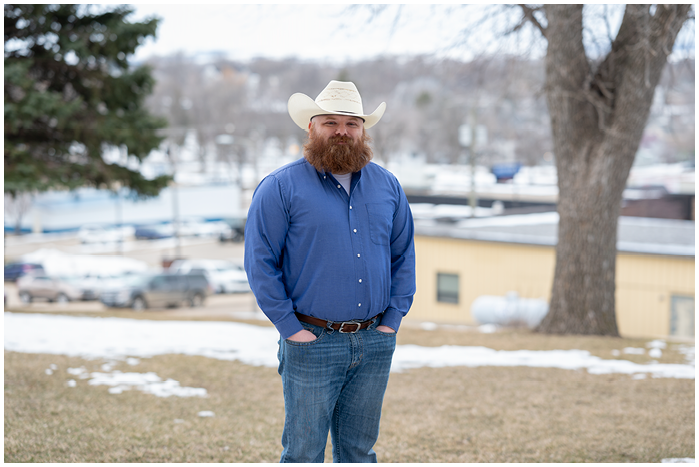
Today, Dylan Kirchmeier is a rural lawyer in South Dakota. Kirchmeier is the prosecutor for Roberts County, which has just over 10,000 people. The Sisseton Wahpeton Oyate reservation covers most of the county, including the county seat of Sisseton where Kirchmeier practices.
In 2013, though, Kirchmeier was a high school student serving as a page in the South Dakota legislature. One day, while attending a committee hearing, Kirchmeier heard debate about a proposed bill to provide incentive payments for rural South Dakota lawyers. That bill became law. Kirchmeier decided to become a lawyer with the intention of using the program to start a career in rural South Dakota. In 2020, Kirchmeier graduated law school and entered the program.
Rural lawyers are declining in number, and the real question is whether the trend can be reversed.
The legislative process that Kirchmeier saw led to South Dakota’s Rural Attorney Recruitment Program, the nation’s first – but certainly not last – attempt at solving the rural lawyer shortage. This chapter introduces various policy responses to the rural lawyer shortage, including South Dakota’s legislation and strategies tried in other states. After surveying what is happening across the country, this chapter introduces the rest of the lawyers who have taken part in the South Dakota program.
Turnaround opportunities
Rural lawyers are declining in number, and the real question is whether the trend can be reversed. There are skeptics – a Kansas judge says there is no “realistic solution” to the lack of rural lawyers. A North Dakota justice told me his own state’s Rural Attorney Recruitment Program is not going to solve access to justice problems. But there are also those who see rural communities, and rural law practice, as having a level of resiliency that will allow growth.
In writing more broadly about rural communities, David Brown and Kai Schafft track the reversals of migration to and from rural areas since the 1970s. The turnarounds in rural population growth have been brief, and overall rural areas have lost population, especially in comparison to urban and suburban communities. But there have been moments when rural areas have become popular, most recently during the COVID-19 pandemic as more space became appealing and remote work became possible. With greater internet connectivity, living in rural America is less isolating than it once was and rural people now have access to much of the information available to those in urban areas. Brown and Schafft argue that movement to rural areas will only occur when rural economic conditions are good. Certainly, for lawyers a rural legal practice will be more tempting when the economy is good enough that clients can pay. On the other hand, rural practice may be more enticing when urban lawyers are struggling in a down economy.
When [Sarah] Thorne surveyed her fellow law students…, over 80 percent said they would consider rural practice in exchange for partial student loan forgiveness.
Sarah Thorne was a law student at the University of South Dakota during the 2008 financial crisis when lawyer jobs were in short supply. Thorne was part of a law school cohort where many new graduates were, in her words, “going to have to just go out on our own and attempt to wing it” in law practice. The firms in cities were not hiring; many government agencies had hiring freezes. At Thorne’s law school orientation, Chief Justice Gilbertson of the South Dakota Supreme Court spoke about pursuing practice in small towns. Later, when Thorne had to draft legislation for a class assignment, she drafted legislation authorizing loan forgiveness for rural lawyers. Amazingly, when Thorne surveyed her fellow law students for her research, over 80 percent said they would consider rural practice in exchange for partial student loan forgiveness. This is not exactly what Brown and Schafft predict about rural migration because the rural economy was not good at the time, but it (at least hypothetically) offered some comparative advantages, including loan forgiveness as an offset to poor economic conditions. Of course, there was no loan forgiveness program for rural lawyers, and 80 percent of Thorne’s classmates did not head out to practice in rural South Dakota. Yet, that law student paper planted seeds for policy changes to come.
The Rural Lawyer: How to Incentivize Rural Law Practice and Help Small Communities Thrive (Cambridge 2025)
 The Rural Lawyer takes a close look at the challenges facing small-town America, where populations are dwindling and aging lawyers are not being replaced by new graduates. With interviews and personal accounts, the book shows how incentive programs can address this access-to-justice crisis. It specifically examines the South Dakota Rural Attorney Recruitment Program, which is the first program of its kind in the United States and has seen great success in helping to attract new lawyers to small towns. Chapters also explore the larger context of rural economic development and its relationship to the law. With insightful analysis and real-life examples, The Rural Lawyer provides readers with a deep understanding of the challenges facing rural communities and the role that lawyers can play in helping these areas thrive
Thorne’s paper was passed onto Chief Justice Gilbertson, who was already advocating for some sort of program to incentivize rural practice. Gilbertson started his career as a rural attorney in 1975 in his hometown of Sisseton, population 2,428. After he became a member of the Supreme Court, Gilbertson regularly drove across rural South Dakota for decades. After noticing rural firm after rural firm disappear as attorneys retired or died, Gilbertson began to think about how to recruit new rural attorneys. Early on, Gilbertson realized the financial limitations faced by new graduates with high student loans. In consultation with the executive director of the state bar association, he decided that “the best way to encourage small town attorneys” would be “some kind of a financial incentive to take the fear” out of going to a small town.
As the state’s Chief Justice, Gilbertson addressed the legislature every year in his State of the Judiciary Address. Gilbertson started talking about the rural lawyer shortage in these addresses in 2005. For several years the legislature did not respond to Gilbertson’s call to action. But then in 2013 State Senator Mike Vehle came to visit Gilbertson a few days after the speech. Vehle sponsored legislation, but in an environment where other work was already happening behind the scenes.
Pat Goetzinger, a lawyer practicing in South Dakota’s second-largest city, was elected as the state bar president for the 2011–2012 term. Goetzinger came from rural South Dakota, having grown up in Martin, population 941. Goetzinger saw the lawyers in his hometown disappearing during the same time that Chief Justice Gilbertson was starting to talk about the hollowing out of the rural bar. Goetzinger read Thorne’s law school paper, and, at the urging of Gilbertson, Goetzinger spoke with Thorne about her idea for incentivizing rural practice. Tom Barnett, the executive director of the state bar, was crucial in forging these connections for Goetzinger and in ultimately supporting his vision. Goetzinger adopted rural recruitment as his project for his year as state bar president.

Once Goetzinger decided to focus on rural lawyers during his term as state bar president, he still needed to do something. With the help of Tom Barnett, Goetzinger launched a task force, bringing Bob Morris – a small-town attorney and past president of the state bar – to chair the task force, which became known as “Project Rural Practice.” The task force began by bringing together stakeholders, including county commissioner representatives and municipal representatives, then brought together what Goetzinger called the “big three” – the state bar, the Unified Judicial System (basically, the judiciary and the administrative wing of the judiciary), and the state’s only law school at the University of South Dakota. With the law school under the deanship of Tom Geu, originally from rural western Nebraska, the “big three” were all led by men who grew up in rural America.
Goetzinger heard skepticism from many people, but he had Chief Justice Gilbertson, Barnett, Geu, and Morris on his side, meaning the judicial system, the law school, and the state bar had a strong coalition to make something happen to resolve the rural lawyer shortage. These men worked hard and built a coalition. They also encountered what Goetzinger called “serendipitous things.” Bob Morris simply called it “dumb luck.” For example, meeting the ABA leadership at a conference and getting national attention through an ABA resolution regarding rural lawyers, which in turn made the national and local news. Goetzinger credits the ABA resolution and media coverage “as a catalyst to crafting legislation” the following year. It helped that Goetzinger’s law partner David Lust was the house majority leader in South Dakota and was an “advocate” and “natural” ally in the legislative effort once Senator Vehle decided to take action.
The legislation
A year after Goetzinger’s state bar presidency and the ABA resolution on rural lawyers, and after years of hearing Chief Justice Gilbertson talk about rural lawyers in his State of the Judiciary address, Senator Mike Vehle “took the initiative to walk into Chief Justice Gilbertson’s office and say ‘are you gonna do something about this, or just talk about it?’” Vehle mentioned stipends for medical professionals and asked about pursuing a similar program for lawyers. Suddenly, there was a partner in the legislature willing to make this happen. The Project Rural Practice Task Force, by then co-chaired by Goetzinger and Morris, stepped back into an advisory role while the program moved through the legislative process. Vehle was not a lawyer, though the prior summer a rural lawyer named Shane Penfield had told Vehle that “small towns really need attorneys” to fix client and community problems, including to spur economic development.
What South Dakota passed into law in 2013 was truly unique.
In 2013, Vehle introduced legislation. Vehle’s first legislation had funding going to law students rather than practicing lawyers; those law students had to have connections to South Dakota; and counties under 12,000 in population could participate.1 The legislation failed in the Senate, but Vehle was undeterred. He listened to critiques, amended the language of the bill, and took advantage of a procedural workaround by “hoghousing” (or taking over) a bill about transfer on death deeds.2 By doing this, Vehle was able to substitute in his rural lawyer bill, this time getting enough votes. Chief Justice Gilbertson found extra money in his judiciary budget to fund the 50 percent match from the state. Lust helped obtain funding approval in the House of Representatives. It passed both chambers and was signed into law on March 21, 2013, by Governor Dennis Daugaard.
What South Dakota passed into law in 2013 was truly unique. Nothing similar had ever happened in a state legislative body in the United States. States had long used financial incentives to attract medical professionals to rural or underserved areas. But incentivizing lawyers to go rural was new. While there was thoughtful planning behind the bill, a lot of fast decisions had to be made. There was no model legislation to follow; no sister state with a law to copy. Instead, the South Dakota team did their best to write something entirely new.
This initial legislation called the program the Recruitment Assistance Pilot Program, limited to a maximum of sixteen attorneys and only available until 2017. Counties under 10,000 in population could participate in the program. Under the legislation, participating attorneys had to stay for five years. If they left before serving five years, they would have to repay the stipends they had received. The stipend amount was calculated based on 2013 tuition at the University of South Dakota School of Law. Unfortunately, “everyone was so giddy” that the bill might actually pass that future inflationary increases were not built into the bill. To be fair, very little could have been done in 2013 to create an effective escalator clause in the legislation. Because a portion of the funding comes directly from the state, any future inflationary increases would need approval from the legislature, secured on an annual basis. Now, program administrators are thinking about how to get legislative approval for an escalator clause, though even with such a clause the budgeting process would need legislative approval. If the stipend were growing with inflation, it would be over 16,000 dollars per year in 2024, rather than stuck at 12,513.60 dollars per year as it was calculated in 2013.
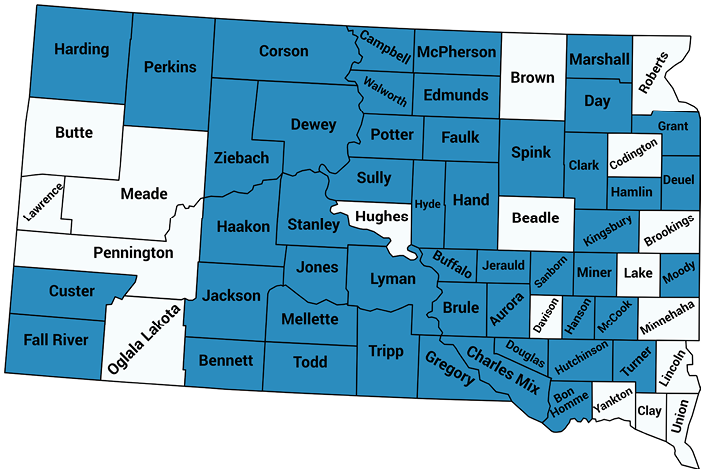
One key piece of the legislation is defining which counties are eligible to participate. The 2013 legislation allowed counties under 10,000, which is admittedly arbitrary. The population line could have been drawn anywhere. Chief Justice Gilbertson originally picked 12,000 as the cutoff, which the first proposed legislation used. The final legislation decreased that population cutoff to 10,000. That population line includes most of South Dakota’s counties as indicated by the darker counties in Map 1.
Senator Vehle insisted that counties have “skin in the game,” so a cost-sharing provision was included to make sure that local counties paid a portion. Counties had to pay 35 percent of the stipend; the state bar 15 percent; and the state – through the Unified Judicial System – 50 percent. That basic structure has remained, though the legislation has been amended three times, as shown in Figure 3. This continued legislative intervention has always been to expand, rather than restrict, the program. In other words, whatever happened to get the conversative South Dakota legislature on board with funding rural lawyers was not a fluke. The people working behind the scenes feel like luck was involved with the legislative approval, yet the constant reapproval and expansion from the South Dakota legislature demonstrates that the political branches feel things are going well enough to continue investing in the program.
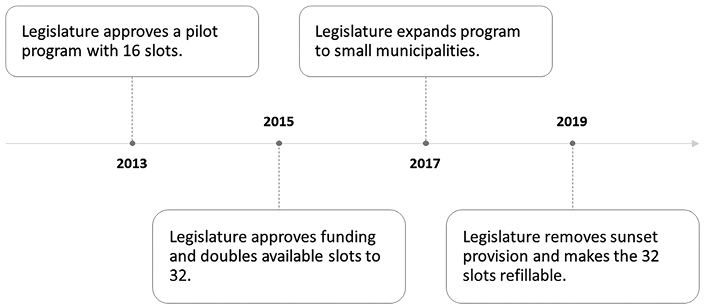
As the timeline in Figure 3 encapsulates, the three additional legislative actions occurred in 2015, 2017, and 2019. In 2015, the legislature approved 500,000 dollars in expenditure authority to fund the incentive payments.3 That same legislation extended the time frame to 2022 and doubled the number of slots, allowing thirty-two attorneys to participate. Two years later, in 2017, legislation removed the “pilot program” language and expanded the program to allow small municipalities in more populated counties to participate.4 Then, in 2019, the program was extended again – this time making the legislation permanent by removing the sunset provision entirely and increasing the ability of lawyers to participate by allowing thirty-two attorneys to participate at any given time, but imposing no limits on the ultimate number of attorneys who can ever participate.5
More programmatic changes have been decided at an administrative level without requiring legislative approval. These have included changes to pro bono requirements, mandatory mentorship, and making full-time prosecutors ineligible. The trial and error of the South Dakota program was inevitable, but also not problematic. The team of people invested in the program’s success have been able to navigate necessary changes to keep the program working for South Dakota. Chief Justice Gilbertson retired in 2021, and current South Dakota Supreme Court Chief Justice Steven Jensen now talks about the program as one that is flexible except where constrained by legislation. Jensen’s view is a useful one – one of the takeaways from the interviews I conducted is that flexibility is important. Because the program was a first-of-its-kind approach, the people running the program have been open to change over time. The Project Rural Practice task force continues to innovate, including, in October 2024, setting up several new working groups to strategize future improvements. Because the authorizing statute is broadly written to allow various locations and types of practice, the program has been more successful for more rural attorneys than a narrowly drawn program would have been.
Other policy responses
At the same time that South Dakota was working its way through the first ten years of the Rural Attorney Recruitment Program, other states were considering whether to attempt something similar. In 2021, North Dakota, through administrative rule rather than legislation, created a program almost exactly like South Dakota’s. The usage in North Dakota has been different, with only four participating attorneys and all four being practitioners who were already in their rural areas when they applied for and received the stipend. One more state – Illinois – offers a stipend to rural lawyers. Illinois is substantially less at only 10,000 dollars maximum, though requiring only a one-year commitment. Illinois has seen higher numbers of participants, but substantially lower rates of retention in rural communities.
There has been interest in developing similar funded programs in other states, but nothing else has come to fruition. Most of the failed bills were much more constrained anyway. For example, sometimes only for rural public defenders or only for tuition reimbursement.6 Work continues across the country. As just a few examples: Kansas is currently studying solutions to its rural lawyer shortage. The Oregon State Bar recently extended its Loan Repayment Assistance Program to cover rural settings. The Colorado Access to Justice Commission received a 627,000-dollar grant to work on solutions to the rural lawyer shortage. The Dakotas have certainly made the biggest dollar investment for paying practicing lawyers, though other states have invested in different types of programs, which are worth analyzing.
In 2023, law professor Lisa Pruitt collected and categorized different state policy responses to the rural lawyer shortage. Though the programs are constantly in flux and programs have already changed, her categorizations remain useful to understanding policy responses. Beyond stipends to practicing lawyers, like South Dakota, North Dakota, and Illinois have done, there are incubators, succession planning programs, channeling urban resources to rural areas, and expanding pathways to rural practice. There is an even newer strategy being tested in several states, expanding licensing opportunities for lawyers in rural areas.
Incubator programs are designed for new graduates to learn how to launch a law practice. They are often, but not always, associated with law schools. The ABA tracks incubators, reporting over seventy-five programs in existence since 2007, a few of which are rural focused. The incubator system is largely directed at solo practitioners serving low- and middle-income clients. They offer a modest stipend, but provide substantial structured mentorship.
Montana and Arkansas have created rural-focused incubators. Montana Legal Services Association has a rural-focused incubator program with a 24-month commitment from new practicing lawyers. The lawyers go to underserved rural areas, but are given substantial mentorship and training along with loan forgiveness. In Arkansas, the current incubator program is administered by a faculty member at the William H. Bowen School of Law and targeted specifically to its alumni. Lawyers work in underserved rural areas, receiving up to 10,000 dollars in start-up costs for an eighteen-month commitment. Both programs require participants to engage in pro bono work; both programs aim to provide the necessary support to make the lawyers launch successfully. The incubator mentorship in Arkansas has relied on volunteer attorneys. After a solid start, the Arkansas incubator was without a director for several years, stalling placements in rural areas. It turns out that sustaining rural-focused incubators has been difficult. California had one briefly, but it shuttered before really getting off the ground. Arkansas, though, is discussing significant improvements to its program.
Other states have developed programming aimed at facilitating succession planning in rural areas. These programs, though, are less developed. Much has been done to connect law students with retiring lawyers, but less to facilitate the actual transition of the firm. In my own interviews with new and retiring attorneys, I heard varied perspectives about what retiring lawyers expect. Some retiring lawyers view succession planning as a way to sell a firm and book of business for a profit. Aspiring rural lawyers in South Dakota told me that they walked away from retiring lawyers trying to charge too much. On the other hand, some retiring rural lawyers see succession planning as an investment to ensure a new attorney comes to town to take care of their clients. A lawyer like this, instead of charging the new attorney for “buying” the practice, might sell a building or its contents, but then spend time and lose money helping the new attorney take over. No program has successfully targeted resources at older attorneys as an incentive for them to train and hand off offices.
Then there are the programs that bring urban lawyers and resources to rural areas. A Minnesota project called “Justice Buses” encapsulates one strategy – taking lawyers from more urban areas, putting them on buses, and having them bring legal services to more rural communities. These types of programs are most often conducted through legal aid offices and law school clinics. Short-term legal assistance is not as good as permanent local counsel. However, these programs are usually providing free services to clients that likely could not afford to hire a local lawyer, even if one were present.
The largest grouping of state programing can be lumped together and generally described as pathway programs.
Another way to leverage urban resources to serve rural communities is through the use of technology. For decades, there have been proponents of using technology to provide legal services in rural areas. However, rural areas still have technological deficiencies that prevent this from being a real, long-term solution. Urban lawyers providing representation in rural areas may successfully fill gaps in legal assistance, but it cannot be a primary path forward. Urban attorneys are unfamiliar with local norms, both in and outside of the courtroom. Local issues often need local solutions, though specialized attorneys in urban areas certainly provide critical assistance in more complicated matters when rural lawyers want to make referrals.
The largest grouping of state programing can be lumped together and generally described as pathway programs, though those come in a variety of packages. Nebraska has the most robust system, with the Rural Law Opportunities Program. Nebraska recruits rural high school students as they enter college, providing an undergraduate scholarship and exposure to law school and rural law practice. This program sees students through four years of undergraduate education and three years of law school. That long-term investment means that Nebraska is only now seeing graduating lawyers come out the other side, with several initial graduates choosing not to practice in rural areas. Other programs are less time- and resource-intensive, but also attempt to encourage prelaw students to consider rural practice.
Law schools themselves take part in encouraging rural practice by offering rural courses and clinics to law students. Law school students take part in job fairs and mentorship programs with rural attorneys. Summer stipends for law students, whether through the school or state bar, can bring those students to rural areas when no local attorney can afford to pay a summer intern. Those funded stipends can help with building connections between aspiring rural lawyers and rural practitioners.
There is also an opportunity for each school to support rural lawyers after graduation through Loan Repayment Assistance Programs (“LRAPs”). In looking through LRAP terms for the top 140 law schools, my best guess is that about seven law schools would cover rural practice, with only Michigan and Berkeley explicitly mentioning rural practice in their policies. LRAPs are generally only available at larger, more expensive schools, but they can provide loan forgiveness for rural practitioners not covered by federal loan forgiveness.
Finally comes the nascent policies focused on easing licensure requirements with the goal of expanding the pool of attorneys willing to go to rural areas. In 2023, the Nevada Supreme Court issued a rule allowing twelve months of limited practice for law school graduates working full time for legal aid, rural prosecutor, or rural public defender offices. Several more states have policies that allow alternative pathways to full licensure, though the programs are not aimed specifically at rural lawyers. In South Dakota, a committee has recommended a pathway program to licensure for traditional public service jobs or for private practitioners working in communities that qualify for the Rural Attorney Recruitment Program. The South Dakota Supreme Court, in 2024, continues to move forward with the proposal, which would create a pilot program allowing students heading to rural areas or public interest jobs an option to submit a portfolio rather than take the traditional bar exam.
All of these programs – from funding for lawyers, to recruitment, to loan forgiveness, to eased licensing requirements – can play a role in recruiting and retaining rural lawyers. For a relatively young policy issue, a lot has been tried. Without a doubt, some rural lawyers have been incentivized by these various programs. This book’s focus is on the South Dakota program because it was the first and remains the most expansive. Now with a ten-year history to study, there is enough information to start understanding how a rural lawyer incentive program works in practice.
The South Dakota lawyers
After Governor Dennis Daugaard signed the initial legislation in 2013, the recruitment process began in South Dakota for the rural attorneys and rural communities who wanted those lawyers. Jake Fischer was the first participant to enter the program, Clay Anderson the second. Then, in the first ten years of the program, thirty more lawyers followed with signed contracts and boots on the ground in their rural communities. Those thirty-two attorneys – and their successes and failures – are the focus of this book. A bit more about those attorneys is needed by way of introduction.
At the ten-year mark of the program, in 2023, there were twenty-four participating attorneys practicing law in their rural communities. Twenty-four of thirty-two attorneys, then, are still in their rural communities. The other eight left rural practice. Three participants – Jake Fischer, Casey Jo Deibert, and Amanda Work – completed their five years then left their rural communities. Fischer returned to Minnesota, his wife’s home and where he attended law school. Deibert and Work both moved to Pierre, South Dakota, where they work as government lawyers.
Five participants left during their five-year obligations. Evan Hoel had – by far – the shortest stint. He was in rural practice for only three weeks before moving to Rapid City to work as a full-time public defender. During those three weeks, Hoel had done some work as an assistant prosecutor but had not yet taken on any of his own clients. I include Hoel in the study because I think his experience is useful to understanding the initial stress and concerns that most of these participants had about rural practice. Hoel, though, never acquired clients and never practiced law, so his experience is not reflected in discussions of the practice of law.

Elizabeth Steptoe was in practice less than a year before deciding to step away from the practice of law. Steptoe, though, has deep connections to her rural community, and did not move after leaving rural practice. Instead, she still lives on the same farm but teaches in the local school. Also lasting less than a year was Ryan McKnight, who similarly left for a teaching job. But for McKnight, his job offer was to teach at a college on the other side of the state. McKnight is unique because his wife Brittany Kjerstad McKnight graduated from law school in the same year, and they entered rural practice together. However, the county commissioners were not going to approve and fund two participants. Accordingly, only McKnight had a contract even though Kjerstad McKnight could have been a participant. Kjerstad McKnight is not included in the thirty-two lawyers that form this study, though I interviewed her in the same fashion as those thirty-two lawyers. I bring in her story as appropriate throughout the book because her experiences are very similar to other new rural attorneys.
At the ten-year mark of the program, in 2023, there were twenty-four participating attorneys practicing law in their rural communities.
Two attorneys made it into their second year before departing. Amanda LaCroix was in rural practice for over a year, but health insurance and other factors pushed her to leave. She took a salaried job with the state government in Pierre, which she still holds today. Kasen Lambeth was in rural practice exactly two years before receiving a job offer in the larger community of Vermillion, South Dakota, where he moved. The book explores these departures in more detail, including an analysis of whether the departures can be viewed as policy failures, or whether they are inevitable transitions that happened as part of changing lives.
Of the twenty-four participants still in their rural communities, twelve had finished their five-year commitments by the ten-year anniversary in 2023. Of those twelve with completed contracts, most are full-time rural lawyers, while four attorneys are doing something less than full-time rural practice, though all four continue to be at least a part-time rural attorney. Those four part-time rural attorneys are Dusty Ginsbach who works in the oil fields of northwestern South Dakota; Clay Anderson who is more of a businessman than a lawyer; Jennifer English who contracts with a nearby larger county to do involuntary commitments; and Ashley Anson who is connected with a firm in a larger community, splitting her time between her rural office and its larger office, with plans to transition to a career in counseling.
The other eight attorneys who have finished their five-year contracts are full-time rural practitioners. Kristian Ellendorf, Austin Hoffman, Amy Jo Janssen, Kristen Kochekian, Zach Pahlke, Victor Rapkoch, Jackson Schwandt, and Stephanie Trask are all rural lawyers with no intention of leaving the full-time practice of law.
Then there are the twelve attorneys who were in their five-year contract window in 2023 at the ten-year anniversary. Dylan Kirchmeier and Kathy Zenner are both full-time prosecutors in rural communities with intentions to stay. Kirby Krogman, Rachel Mairose, Abigail Monger, and Mason Juracek have part-time prosecutor positions and part-time private practices – again, they all plan to stay in their rural communities. Then, finally, Rachelle Norberg, Derrick Johnson, Cody Miller, Cole Romey, Austin Schaefer, and Cassie Wendt are rural lawyers who either practice solo or with small law firms – and, again, they all intend to stay.
This group of thirty-two lawyers makes up the Rural Attorney Recruitment Program participants from the first ten years of the program. Their experiences are valuable in telling us about the realities of rural practice in today’s world. This includes where the pressure points are that require assistance, and, therefore, how a rural lawyer incentive program can help.
While there is no racial diversity among the participants, there is diversity of gender, background, and political affiliation. Overall, the participants tend to be from rural backgrounds and tend to be conservative, yet there are participants from larger cities and participants who are politically liberal. There have been seventeen men and fifteen women participate in the program. Equal numbers of women and men (four each) have left the rural practice of law either during or after the five-year commitment.
The wider perspective
New lawyers begin rural legal careers every year, and the story this book tells is a small-scale version of what happens every year in jurisdictions across the United States when new lawyers start practicing in rural areas. But it also tells a story unique to South Dakota, because South Dakota provides a stipend to support its new rural lawyers.
In 2024, NPR ran a story with the headline “One of the World’s Greatest Instrument Collections Is in South Dakota, of All Places.” Can you imagine South Dakota, of all places, having a museum? Apparently that is hard to imagine, at least for NPR. Can you imagine South Dakota, of all places, being the nation’s leader in incentivizing rural practice? I hope so, because it is. Though when the New York Times first introduced this program to the national media in 2013, the Times did not even mention South Dakota in the headline. Instead, it simply announced that “one rural state” had created a rural lawyer incentive program.
South Dakota does not often make headlines for being the best at anything. We have the nation’s best musical instrument museum. We have the nation’s best trust laws (or worst, depending on your perspective). The museum came about by happenstance. The part-time legislature has been able to craft those trust laws with major industry help and as part of a larger economic strategy. Just like relaxed credit card laws boosted the state’s economy, so does the trust industry. South Dakota’s innovations in legislation have nearly always been about earning money, not spending money. It’s not so obvious why South Dakota innovated a program for rural lawyers, even though this government spending is partially for the benefit of helping local economies.
The first-in-the-nation aspect led me to do this deep study of how the program and its participants are faring.
Sometimes it feels like lightning struck in South Dakota – a fiscally conservative state became the nation’s leader in funding rural attorney recruitment. But the real story leading up to the funded incentive program is a story of hard work by invested leaders who were willing to put in years of advocacy to solve a crisis. There were multiple modes of advocacy occurring simultaneously, with multiple people making a difference. There were also, quite frankly, a lot of people with power who care deeply about rural America. This is a state where rural continues to matter, and rural investment is part of the state identity. Combine all of this, and South Dakota has a funded program to help ease the rural lawyer shortage in the state.
The first-in-the-nation aspect led me to do this deep study of how the program and its participants are faring. But let me be clear. Just because my interviews are with South Dakota lawyers does not mean that only South Dakota lawyers can learn from their experiences. In fact, myself and others have heard similar feedback from rural lawyers in other states. I conducted interviews with rural lawyers and policymakers in Arkansas, Colorado, Illinois, Iowa, North Dakota, and Wisconsin. Those lawyers face similar constraints and challenges. Elizabeth Chambliss interviewed private practice lawyers at various career stages in South Carolina’s poorest rural counties. Ashli Tomisich interviewed new lawyers in Wyoming. Even accounting for jurisdictional difference and the different rural lawyers targeted in these studies, the reality of rural practice appears more similar than not across the country.
A Q&A with author Hannah Haksgaard on The Rural Lawyer
The Practice: What drew you to focus on rural legal practice in South Dakota?
Hannah Haksgaard: I grew up in rural South Dakota, and both my parents have deep rural roots, so writing about rural issues is natural to me. Once I became a law professor at the University of South Dakota, I realized I could make an important contribution by studying rural lawyers.
The Practice: What key questions and research motivated The Rural Lawyer?
Haksgaard: When I started research for The Rural Lawyer, the ten-year history of the program was quickly approaching. For almost a decade, South Dakota had received praised for having a ‘first in the nation’ program to recruit rural lawyers, but I wanted to collect data to figure out if the program was actually successful. By doing interviews with the rural lawyers participating in the program, I not only learned about the program itself, but I also learned a lot about the rural practice of law.
The Practice: How do you determine if South Dakota’s Rural Attorney Recruitment Program was a success?
Haksgaard: At the ten-year anniversary of the program, which is the focus of The Rural Lawyer, 75 percent of the lawyers who started the program were still in rural practice. In a world where young adults change jobs frequently, I view 75 percent retention as a success. Several rural communities in South Dakota went from having no lawyers to having one in town. Other rural communities were able to replace a retiring lawyer. This type of program is not fast. Only a few new lawyers will enter the program each year, but every lawyer who makes a career in the rural practice of law means the program is worth having.
The Practice: What’s next – for the recruitment program and your research?
Haksgaard: The recruitment program is still going strong and is working in collaboration with a state bar taskforce to find new ways to support rural lawyers. We were just awarded the Department of Justice’s 2025 Access to Justice Prize to support a new mentorship program. This year I’ll be spending my research time instituting the grant by figuring out the gaps in rural mentorship and how a statewide program can fill those gaps.
Hannah Haksgaard (nee Alsgaard) was born in Kentucky, but grew up outside of Yankton, South Dakota, where she received her K-12 education. She returned to Kentucky for college before attending law school in California. During law school, Professor Haksgaard was an editor on the Berkeley Journal of Gender, Law & Justice and was a graduate student instructor in the Berkeley Legal Studies department for two undergraduate classes: Government & the Family and Reproduction, Sex & the Law. Following law school, Professor Haksgaard clerked for the Honorable Roberto Lange of the District of South Dakota and the Honorable Kermit Bye of the Eighth Circuit Court of Appeals. Professor Haksgaard joined the USD Knudson Law faculty in 2016.
Professor Haksgaard has joined a small group of scholars who write about, and propose solutions for, the rural lawyer shortage. Her scholarship on the rural lawyer shortage has specifically addressed Project Rural Practice in South Dakota, how rural practice serves the public good, the impact of hourly rates for court appointment work, and how incentive programs for rural lawyers can be informed by incentive programs for rural medical professionals. Professor Haksgaard also writes about family law issues. Her scholarship in this area mainly focuses on how family status impacts the ownership of property. She has also written about surname choice at marriage and the impact of rurality in how women access reproductive healthcare.