Everyone agrees that there are areas of high legal need in the United States—places where there simply aren’t enough lawyers or even the right types of lawyers. But many disagree on how exactly to calculate that need.
In 2019 six academics came together to publish, “Legal Deserts: A Multi-State Perspective on Rural Access to Justice,” documenting the rural access-to-justice crisis across six states: California, Georgia, Maine, Minnesota, South Dakota, and Wisconsin. The paper was critical for seeking to alleviate the scarcity of data on the rural attorney shortage. At the time, about 20 percent of the U.S. population lived in rural spaces, the coauthors note. Yet, in those same rural spaces, only 2 percent of small law practices existed.
Today, scholars are still trying to accurately map access to legal services across the United States.
Accurate data helps policymakers understand where and how to spend their time—and what sorts of interventions might help address the access gaps. Would a stipend work to entice lawyers to move to rural locations? Should community leaders tap into already existing institutions, like local community centers or churches? How about models that try to license non-lawyers to help with legal needs? Is it a pure numbers game, or is there more going on?
In this story, we speak to three researchers who have mapped the data in different regions. First, we discuss the approaches of David J. Peters, professor of agricultural and rural policy at Iowa State University, and K. Aleks Schaefer, associate professor of international markets, trade, and policy at Oklahoma State University. Then, we talk to Elizabeth Chambliss, the Henry Harman Edens Professor of Law at the Joseph F. Rice School of Law, University of South Carolina, to understand her mixed-methods approach to mapping rural private practice in South Carolina. What we get is a portrait of why defining “legal deserts” is so challenging, along with how various scholars are contending with it—and what they think after mapping the data.
Defining legal deserts
Growing up on a farm in southwest Minnesota during the farm crisis in the 1980s, Peters became interested in “how rural communities respond to shocks and stressors.” After studying economics and sociology, he began asking a new question: What could bring people back to rural communities? As head of the Iowa Small Towns Project, he concentrates much of his research on rural economic development, especially around health and agriculture. But in conversations with “people in declining communities on how to maintain the grocery store and the health care clinic and the school, another thing that came up a lot was attorneys,” he says.
Schaefer likewise came to the legal desert problem because of intersecting personal ties. After a childhood in rural Texas and Kansas, he went to law school thinking, “Now I’m going to go save the world.” In law school, he quickly realized he was learning about how to weigh and advocate for “this position versus that position,” but less so “what is the right thing to do” on a policy level. He went on to get a Ph.D. in economics, which, he said, allowed him to “quantify the pros and cons,” picking the solution that “might improve people’s livelihoods.”
Analyzing the rural attorney shortage with an economic lens, Peters and Schaefer both found issue with defining some of the terms: What counts as “rural”? What determines a “legal desert”?
“We all have a picture of what urban is in our minds, and maybe what rural is in our minds, but from one person to the next, that picture may be different,” says Schaefer, who worked with Andrew Van Leuven on the paper “Quantifying the Rural Legal Desert Problem: Assessing Access to Justice and Legal Services in Marginalized Communities.” “In reality, life occurs on a spectrum between the densest downtown Manhattan to some areas that my grandparents came from where no one lives anymore,” he adds.
People tend to think you’re either in a legal desert or not, and the data is not that clear.
David Peters, professor of agricultural and rural policy, Iowa State University
Within the federal government alone, different departments and agencies have varied definitions of “rural.” For his study, Schaefer used the USDA Economic Research Service’s “rural-urban continuum,” which relies on the U.S. Office of Management and Budget’s mapping of metro and nonmetro counties, using population density as well as other factors like relationship to labor markets and geography to define the categories.
Defining “legal desert” can be similarly confounding. “Everyone talks about what a legal desert is, but no one can actually say, Well, what is it? Is it a perception issue? Is it a quantity issue? Is it an access issue that you might have attorneys, but if they charge too much and your community is poor and people simply can’t pay to have an attorney, is that what it is? Is it a numbers issue?” asks Peters, who wrote “Understanding Rural Legal Deserts to Inform Public Policy: Identifying and Describing Lawyer Gaps in Non-Metropolitan Counties” with Emma Bartling and Emily Meyer.
In 2020 the American Bar Association first addressed the legal desert phenomena, dedicating their annual Profile of the Legal Profession to the concept and defining legal desert as “less than one lawyer per 1,000 people.”
Peters was skeptical of this classification, which felt too black and white. Instead, he sought to define legal need on a continuum “based on the severity of the shortage,” he says, differentiating what he called emerging (0.6 per 1,000), urgent (0.3 per 1,000), and critical (0.2 lawyers per 1,000) legal deserts. “People tend to think you’re either in a legal desert or not, and the data is not that clear,” he says. Peters also sought to identify legal deserts using a lawyer “gap rate,” or the demand for attorneys minus local supply, rather than just attorneys per population. “Our basic premise was that if you’re in a very small rural community without a lot of large corporations or institutions, then you might have a low attorney rate per 1,000 people, but that might be entirely appropriate for that population size and not a legal desert,” he says.
Neither Peters nor Schaefer found bar membership data to be a useful indicator of legal deserts. State bar data is self-reported and might not accurately reflect current active lawyers available for hire. Instead, Peters used law office data from the U.S. Census Bureau, while Schaefer and Van Leuven drew from Data Axle, a database that combines government sources and independent fact-checkers.
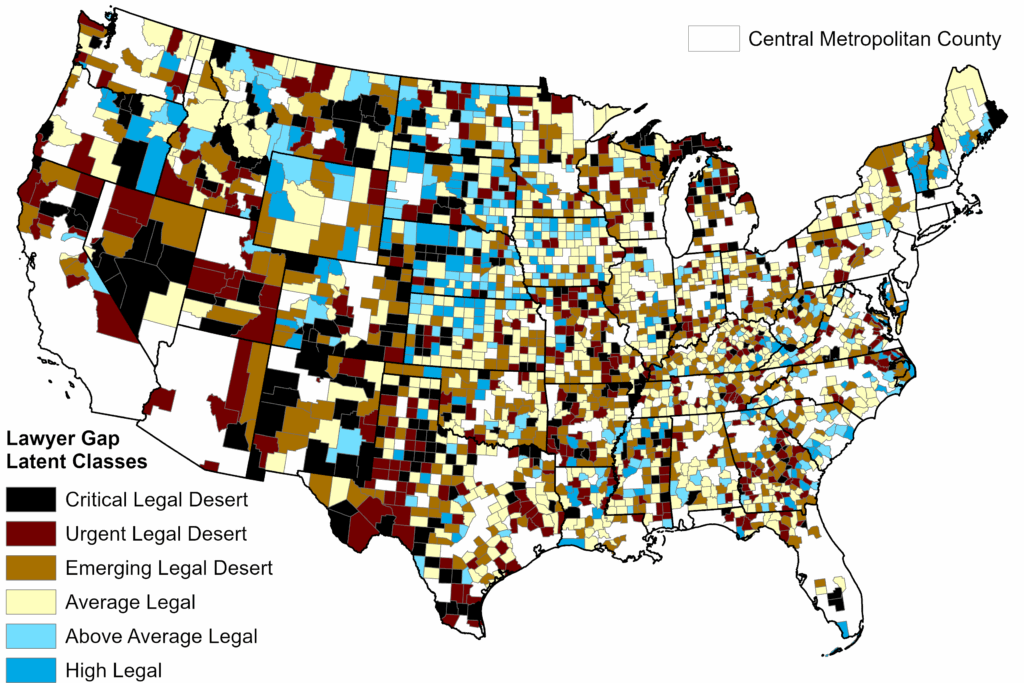
Peters and Schaefer, unsurprisingly, both found a legal desert problem present in the United States. But their papers provide novel information about how the realities of rural life intersect with this issue.
For instance, while Schaefer and Van Leuven found a correlation between the rate of poverty and access to legal representation, they also examined how the presence of a lawyer can bring about positive economic activity in a community. When looking at Oklahoma, for instance, the researchers calculated that lawyers are an economic multiplier, that is, “for every 100 new jobs added in the legal services sector, the regional economy should also benefit from an additional 35 jobs.” More people in rural places means more dollars spent at local businesses and office space and more jobs for paralegals and assistants and so on.
Overall, for his part, Peters calls legal deserts “more distant, disconnected, diverse, and disadvantaged.” It might not simply be a question of more lawyers if those lawyers don’t have the right legal expertise for the area, don’t speak languages other than English, and don’t know how to set up a solo practice.
The country lawyer
“There’s this image of the country lawyer—just some avuncular guy sitting on the porch talking to everybody for free. Very Atticus Finch,” says Chambliss, whose mixed-methods study, “Rural Legal Markets,” provides a portrait of rural private-practice lawyers working in South Carolina—the first of its kind since the 1980s. Chambliss began looking at rural lawyers when she was developing a statewide legal needs assessment with the South Carolina Access to Justice Commission. After mapping the legal aid ecosystem, Chambliss wanted a better picture of the private bar to rectify a reigning “nostalgic view” of “rural lawyers as accessible generalists who serve the public through pro bono, low bono, and community service,” she writes.
Chambliss started with the bar data but then went further. Hand by hand, she and a research assistant culled the data—figuring out which lawyers were active, removing lawyers at nonprofits and in government, and scouring websites to understand how lawyers were marketing themselves. She also knew what bar materials lawyers subscribed to, meaning she knew what they might practice or were seemingly interested in. She combined that work with interviews.
“The number of lawyers in a location doesn’t tell you much at all about what they’re actually doing,” says Chambliss. “Once I did interviews, it was clear that what lawyers say on their website and what they actually do might be totally different. Their website could be aspirational or they had their niece do it. It’s not clear that it really represents their day-to-day.”
There’s this idea that if you just get more private lawyers into these communities, they will serve the whole community. And I’m just not sure that that’s entirely true.”
Elizabeth Chambliss, Henry Harman Edens Professor of Law, Joseph F. Rice School of Law, University of South Carolina
South Carolina has an access-to-justice problem, Chambliss’s research makes clear, and this problem intersects closely with rural areas. For instance, the National Center for Access to Justice Attorney Access Index and the ABA’s count on lawyers per 1,000 put South Carolina in last place. But are solo and small-firm practitioners in rural areas fulfilling that need? Chambliss’s research says no.
Her study revealed the difficulties inherent in operating as a solo in an area with high poverty and high legal need. She found that a high volume of personal injury settlement mills operating in urban areas have pulled personal injury work away from rural lawyers—the occasional car accident used to be an important way for local small-town lawyers to subsidize free and reduced legal services for family or criminal law.
“In our statewide legal needs study, the legal aid lawyers complained that none of the private lawyers do pro bono,” she says. “There’s this idea that if you just get more private lawyers into these communities, they will serve the whole community. And I’m just not sure that that’s entirely true.”
Myth-busting
Crunching the numbers revealed surprising truths for all the researchers. Peters was interested in what role money played in motivating rural lawyers to move to legal deserts. Everyone knows that city lawyers earn outsize amounts, he says, but what about lawyers in legal deserts compared with other nonmetro locations? The data was surprising. “Despite differences in law office sizes, we find that lawyers in rural legal deserts earn about the same as lawyers in other non-metro counties. Average earnings range from $44,710 per job in emerging deserts to $48,540 in critical deserts,” Peters and his coauthors write.
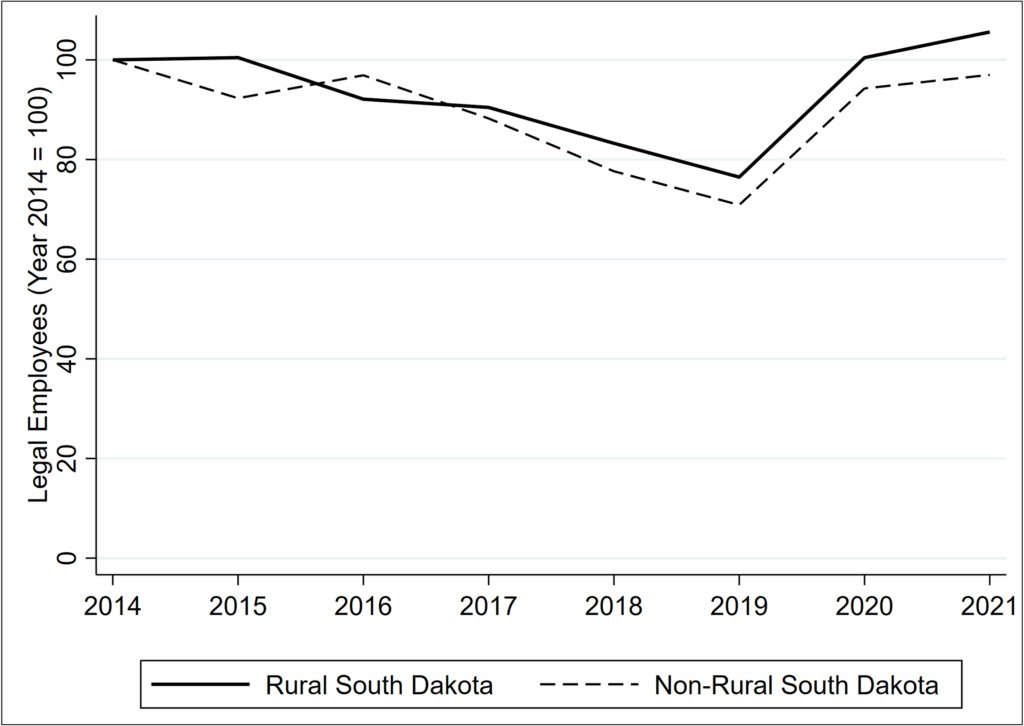
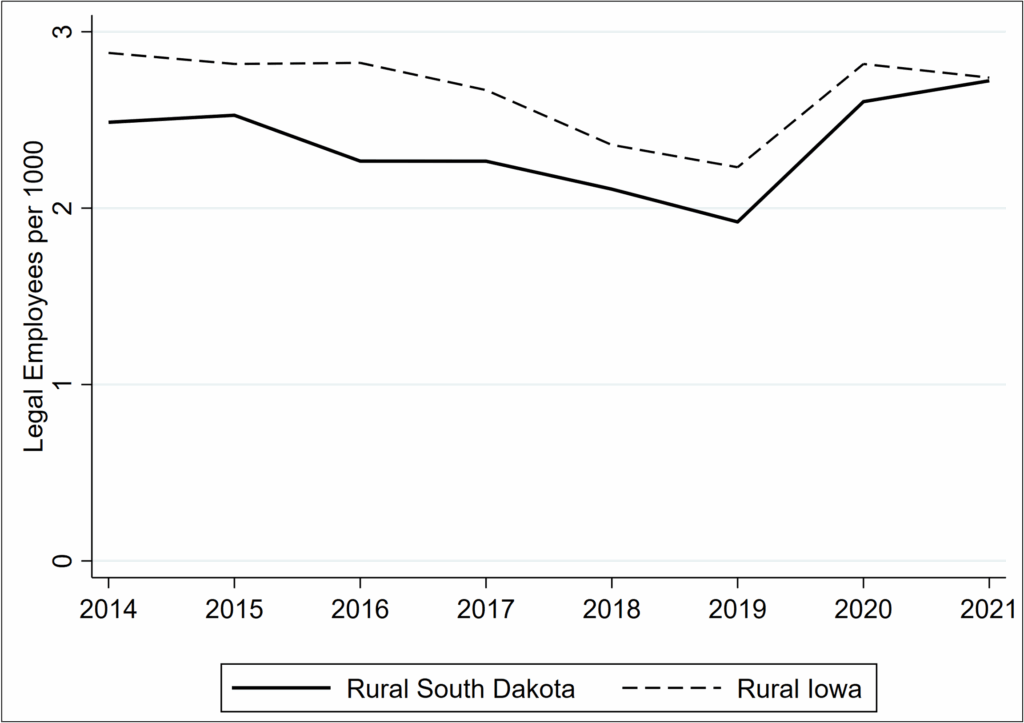
Schaefer was also interested in pay. In particular, he was intrigued by the South Dakota Rural Attorney Recruitment Program, which offered a “real-life science experiment.” Could a stipend make enough of a difference to incentivize lawyers to serve South Dakota over the program’s nearly decade existence? Comparing nonrural counties in South Dakota, rural counties in Iowa, and rural counties in South Dakota over the period of the Recruitment Program’s existence showed substantial gains toward “mitigating the rural legal desert problem in South Dakota,” his study notes. In 2014 the “rural legal coverage gap” between South Dakota and Iowa was roughly 0.5 attorneys per 1,000 residents. In seven years, that gap almost disappeared.
Schaefer was surprised. The Rural Attorney Recruitment Program provides a modest stipend—just over $12,000, or equivalent to what one year at the University of South Dakota Law School was in 2013—each year for five years. But he saw it as a “temporary program that didn’t, to my eyes, go the full way of compensating that chasm of the trade-off of urban versus rural,” he says. Why did it work, in his view? The program is more than a stipend, he says. It’s saying, “Look, we have this problem, this inherent problem in rural South Dakota or rural America more broadly,” he says. “When you show that problem to the law students, you can show them that they’re helping to solve this problem. So it becomes bigger than, Am I going to go home to my hometown versus the big city, or am I contributing to this bigger issue?”
Chambliss, who combined mapping with interviews, found discrepancies between what lawyers advertised and what they did. “The lawyers I spoke to would sometimes start by saying, Oh, I do a little bit of everything, and they would present themselves as a generalist. And then I’d ask, Well, what percentage of your practice is real estate? And they say, 90 percent. And it’s like, OK, so maybe you do a little bit of everything once in a while, but 90 percent of your practice is a real estate practice.” If a community has no one to do wills and estates or family law, but the single lawyer for 60 miles is doing mostly real estate, then legal needs are left on the table. Figuring out how to calculate demand is the next piece of the puzzle for many researchers.
Beyond legal deserts
In 2014, Lisa Pruitt and Bradley Showman authored “Law Stretched Thin: Access to Justice in Rural America,” a now-seminal piece of scholarship arguing that a “thin” conception of access to justice looks at the issue too narrowly: it’s not simply, can a person find a lawyer and figure out their issue in the court? What we need, the coauthors say, is a “thick” access to justice—understanding the systemic issues in a community from the ground up and starting there. “The most effective community service would address both the immediate need and the underlying issues because treating a symptom (e.g., hunger) of a larger problem (e.g., joblessness) is a limited panacea,” they write. (For more with Pruitt, see “Confronting Antirural Bias.”) In that piece, Pruitt and Showman deride the lack of “detailed data” to determine how great the rural attorney shortage was and is.
Today dozens of researchers are mapping legal deserts. A 2022 Legal Evolution blog post by James Teufel and Michael Gallo at the Utah Office of Legal Services Innovation estimated that, assuming no redistribution of current lawyers, it would require 10,000 more lawyers to eliminate all legal deserts across the United States. But that’s only numbers.
Robust efforts from the National Center for State Courts have begun using GIS to drill down on access to justice across a number of states. Their data factors in not just the number of attorneys compared with the population, but their ages, as well as other characteristics about the area, including common language proficiency, internet access, distance to a courthouse, income distribution, and more.
Why is it necessary to create such a complex portrait of intersecting need? To find where aid should go and how it should be distributed, many of these research papers communicate.
Chambliss is skeptical of rural attorney recruitment programs as a strategy for expanding access to low- and no-cost legal services, although she agrees that private lawyers play other important roles in rural communities. Plus, she notes that such programs are hard to scale. “I don’t think we’re going to recruit our way into curing legal deserts,” she says. Subsidies, if states use them, should focus on practice areas of need, like family or criminal law, she adds. A number of states, including Utah, Arizona, Minnesota, Oregon, and recently Colorado, have licensed paraprofessionals to provide legal advice and representation in limited practice areas like landlord-tenant cases or family law.
It’s not just lawyers that we lack in rural areas—it’s doctors, it’s veterinarians, it’s all of these high-skilled, highly educated social capital building institutions that we are seeing dry up.
K. Aleks Schaefer, associate professor of international markets, trade, and policy, Oklahoma State University
Peters thinks his legal desert classification system—emerging, urgent, and critical—could help sort out where money should go. “We see that as a way to inform policy and say, If you’re going to get a large subsidy from the government, then you need to practice in one of these critical legal desert counties,” he says.
“Maybe the issue is itself much bigger than just legal deserts, right?” says Schaefer. “Because when we think about rural America on a bigger scale, this brain drain has now played out over multiple generations.” He goes on:
It’s not just lawyers that we lack in rural areas—it’s doctors, it’s veterinarians, it’s all of these high-skilled, highly educated social capital building institutions that we are seeing dry up. And so when we think about the legal access issue over time, you have to think about it in that context. There has to be some sort of broader policy initiative to balance that gravitational pool of urban areas and all of these high-income sectors relative to what it would take to convince people to move to rural areas.
Schaefer is calling for “broader revitalization efforts.” Peters agrees: “There’s a whole other set of factors that contribute to why someone might not move to a rural area.”