
In the United States, few decisions put the question of value under a brighter spotlight than higher education: a six-figure investment made at age seventeen whose returns may not arrive for decades. But economic uncertainty, political polarization, and advances in AI are rewriting how we think about that value. Indeed, Americans’ confidence in college education is declining. In 2010, 75 percent of Americans rated college education as “very important”; in 2025, that percentage was only 35 percent, according to Gallup. Federal government layoffs and greater restrictions around research funding for universities have not helped, further destabilizing a labor market for graduates that was still recovering from the COVID pandemic.
In “How Lawyers Add Value in the Age of AI,” Michele DeStefano asks what human aspects lawyers can bring to their work that is irreplaceable. DeStefano’s question of value is connected to a bigger one around how individuals can meaningfully set themselves up for success and build careers with longevity. People go to law school because they think it might be a good path: they want to devote themselves to justice while earning a living wage. Beyond law, how should society think about what field brings the best return on investment, through earnings but also through contributions to society?
Higher education and the labor market
When the media decries the use and misuse of American higher education, they miss a few things, including how “the labor market actually works,” says Jeff Strohl, research professor and director of the Georgetown University Center on Education and the Workforce (CEW). Each May, he says, the university system “dumps about 3 million college graduates into the labor market.” It usually takes about nine months for them to find their footing and for the market to stabilize, he says, at which point we do it all over again. The COVID pandemic and reductions in the workforce have further compounded the situation.
As reported by the Federal Reserve Bank of New York, the recent college graduate unemployment rate (ages 22–27) currently hovers at 5.6 percent, up from 3.6 percent in March 2019. The Fed’s own study attributes 64 percent of this increased unemployment to remote work, not to AI. After all, it’s harder to train young employees when offices remain distributed.
Strohl has been critical of measures for “underemployment”—the term used to describe when people are not fully using their skills or degrees in their jobs. Some reports on underemployment list it as high as 52 percent. “If you buy that, we might as well just shut down the post-secondary system because you’re telling me that it works barely more than a coin flip,” Strohl says. “That is unreasonable if you look at the history of how bachelor [degrees] have an earnings premium and how they succeed in the labor market.” Careers take time to establish, CEW’s report on underemployment explains, and one job will lead to another where on-the-job training both enhances old knowledge and instills new skills.
Careers take time to establish.
David Wilkins, faculty director of the Harvard Law School Center on the Legal Profession, has spent decades reassuring his students that they will have, on average, two to four jobs in the first 10 years of their career. To some, that might mean a lack of stability. To others, it’s a reminder that careers are long, fluid, and flexible. But this adage doesn’t just apply to law students. Research from the World Economic Forum shows that by age 55, people hold an average of 12 jobs. And in the future? WEF’s 2023 Future of Jobs Report encourages individuals to get used to having multiple careers, not just jobs.
David Deming, Danoff Dean of Harvard College, Isabelle and Scott Black Professor of Public Policy, and William Henry Bloomberg Professor of Economics, advises students to think in decades, not years. “One thing that is often missing in the conversation over higher education is the time horizon over which people expect a degree to be valuable,” he says. Education pays off in the long run, he explains. “It’s an investment, so the cost comes up front.” Data supports this. In a 2023 piece for The Atlantic, “The College Backlash Has Gone Too Far,” Deming examined both the college earnings premium—the amount bachelor-degree holders can expect to earn over those with a terminal high school degree—as well as the college wealth premium—the earnings premium minus the costs. Although the latter figures might not be quite as optimistic as the former, depending on how you calculate them, Deming still arrived at the same conclusion: people are better off with higher education under their belt. They just have to wait.
“We are effectively asking a 17-year-old high school student to delay gratification until age 35 or later—longer than they have been alive. But the rewards are worth it,” he writes.
What’s in a major
Not all college education is created equal. Where you come from, where you go, and what you major in all play a role. In “The Major Payoff: Evaluating Earnings and Employment Outcomes Across Bachelor’s Degrees,” CEW examines how different majors fare when it comes to future earnings. Want to make the most money? Major in petroleum engineering where the median earnings are $146,000. The least? Education and public service show a median sitting around $58,000.
Some other insights from CEW’s report that stand out:
- Unsurprisingly, arts and humanities degrees have seen declining enrollment in the last 15 years, while STEM and computer science have seen increasing enrollment.
- Graduate degrees make a difference. Certain undergraduate programs with lower median earnings might be “gateways” to higher-earning fields. For instance, median earnings for a terminal health and medical bachelor’s degree is only $70,000, while those who pursue further education see median earnings of more than $150,000.
- It is also important to recognize the relationship between jobs and licensure—certain occupations, like doctors, lawyers, and teachers, require further training (and further debt) to work in their respective field. For some of these, the graduate earnings premium might look like less of a boost because the baseline earnings might already be high (for example, a bachelor’s in business versus an M.B.A.).
- Race and gender stratification exist in major distributions and with respect to post-graduate earnings. “Black/African American, Hispanic/Latino, and AI/AN workers earn substantially less than the median, while women are still disadvantaged by a gender wage gap that becomes more pronounced with higher levels of education,” CEW’s authors write.
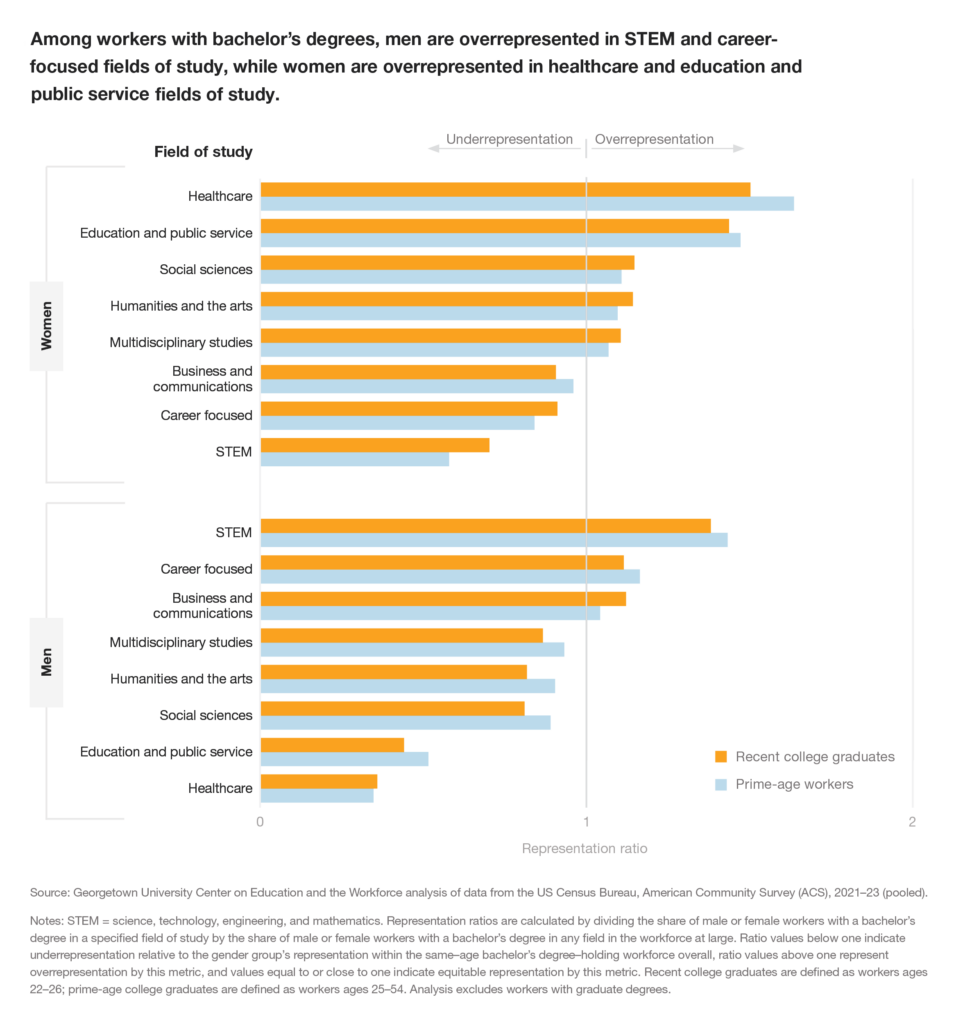
Moreover, a recent working paper from Zachery Bleemer and Aashish Mehta’s research, “College Major Restrictions and Student Stratification,” suggests that even when those from underrepresented groups attempt to pursue majors in fields associated with higher pay, difficult required classes or GPA cutoffs might keep people from pursuing those majors, filtering students toward less lucrative fields.
Because gaps exist between different majors—and the cost of higher education is high—it’s important for students to have robust data about what fields might best prepare them for the life they want to lead, even if earnings might not be the only factor students should consider when choosing their major.
What we’re doing with general education is imbuing flexibility—the ability to respond to change in the labor market.
Jeff Strohl, research professor and director of the Georgetown University Center on Education and the Workforce
For the past decade, many have thought majoring in computer science was a guarantor of, at minimum, a job, and perhaps even high earnings. Indeed, CEW’s research, which uses data from 2009–2023, indicates that the median earnings for prime-age workers in this field is $116,000. With AI’s encroachment on basic software engineering, however, some have predicted computer science majors may drop. “From 2005 to 2023, the number of comp-sci majors in the United States quadrupled,” Rose Horowitch writes in The Atlantic. In 2024, the number grew but grew by only 0.2 percent. Preston Cooper, senior fellow at the American Enterprise Institute, estimates that the number of computer science majors was already inflated and that students should have never looked at it as a surefire path. Still, he says, even as AI might replace some of the more basic tasks in the field, recent numbers from the Bureau of Labor Statistics indicate that software engineering roles are still expected to increase in the next decade. For those with computational sophistication and AI fluency, such majors could lead to working more productively in existing or newly created roles.
At Harvard, Deming says, there has been a drop in the number of people choosing computer science as a major. But, he says, “that’s a decline from a very high base.” Even if the “pipeline of computer science major to guaranteed job is probably not there right now,” he says, “it’s not there for most majors and it never was going to be.” In other words there are cycles. “If one of my kids wanted to major in computer science, I would say great,” he says. “I think actually being able to think computationally is pretty valuable.”
For Strohl, what matters more than the major you choose is that you finish at all. Those who start college but never finish enjoy the worst of both worlds: high debt without the boost that comes with having a degree.
What does this mean for law school?
As Meghan Dawe has previously demonstrated in The Practice, law school debt weighs on certain populations, especially Black men and women, more than others. This has critical implications for democratic ideals, Dawe writes, as those who enter the legal profession are tasked with upholding justice in the U.S. Still, as other research from the After the JD project reveals, those who attend law school rarely regret it.
Research from CEW indicates that attending law school generally does promote an earnings boost, above a terminal bachelor’s; however, this boost is quite limited, the research says. Who benefits the most? Those who attend the top schools.
When economists Frank McIntyre and Michael Simkovic tried to estimate the value of the JD in 2016, they found that different undergraduate majors predicted different earnings premiums post law school. For instance, liberal arts majors in humanities or social sciences saw the biggest boosts, but that was likely because STEM and economics majors had higher baselines from a terminal bachelor’s. During times of economic uncertainty, law school applications tend to increase, with students seeking secure career paths and further education, even as the number of law jobs available has been dwindling. (Research has generally seen an increase in higher education during recessions, as individuals seek to retool themselves for an unknown future and see no downside from sitting out the labor market.) According to LSAC, the 2024 law school graduating class saw 1,800 fewer job openings than the class of 2007 (pre-recession).
Meaning beyond money
Value is about more than dollars and cents. Deming has noticed something encouraging: more students telling him they want to pursue humanities degrees. Part of it may be practical: “If nothing is guaranteeing you a job, then you’re more likely to pick something you’re interested in,” he says. But part of it may be something deeper: a generation genuinely wrestling with what it means to be human in an age of AI, he says.
If American college was merely meant to provide a direct entryway to a career, it would be structured differently. In many other countries, students often apply directly into universities with a chosen major, including professions like law or medicine, where the curriculum is highly regimented. Strohl believes that a liberal arts education is a feature, not a bug. “What we’re doing with general education is imbuing flexibility—the ability to respond to change in the labor market,” he says.
“You need your education to last you 40 to 50 to 60 years of working life,” Deming says. “And so it needs to be the kind of thing that’s helpful to you, not just in today’s technological environment but [in] the revolution that’s coming and the one after that and the one after that.” Some of Deming’s research on what is valuable in the workplace focuses on the increasing importance of social skills—something that might blossom during university even if you’re not graded on it.
I think you don’t actually want your life to be predictable.
David Deming, Danoff Dean of Harvard College, Isabelle and Scott Black Professor of Public Policy, and William Henry Bloomberg Professor of Economics
Strohl says that the idea of “return on investment” has overtaken the conversation, a valid topic in an uneasy economy and rising costs. “But what gets lost is the consumptive value of education,” he says, “meaning that when you go to college, you actually have an enjoyment factor that brings a certain utility, a certain gain by enjoying your classes, having an appreciation of learning.” There are also civic and health benefits associated with higher education.
Moreover, some careers hold high value for society but might not show up as valuable in terms of earnings—something Christina Whitfield tries to measure on a “social utility index.” Public service and education are critically important for society but have some of the lowest median earnings. Students may value the types of other benefits that come with such jobs—tenure, government benefits, stability, summer vacation—even if it does not show up in the paycheck. “Many people would trade some amount of earnings for a more rewarding job, more flexibility and predictability in schedules and location, greater opportunities for advancement, or more autonomy,” write Sandy Baum and Kristin Blagg for the Urban Institute.
Deming understands how demoralizing it might be for students graduating into this economy. But, it is precisely during times of adversity that creativity, entrepreneurship, and invention have historically blossomed, he reassured this year’s 2026 graduating class. “I think people have this idea that they’re going to get to happily ever after. Okay, I found the path. I know what I’m doing and that’s it,” he says. “If I had done that, and if many of us had done that, we would have not taken advantage of some really interesting opportunities that came our way. I think you don’t actually want your life to be predictable.”
Image credit: Shutterstock // Andrey_Popov